
No single number answers this question, because a solo service and a storefront are different businesses.
This guide gives you three budgets instead: a service launch, an online shop, and a small storefront.
Each budget splits one-time costs from monthly costs, then adds the cushion beginners forget. Replace every figure with your own quotes before you spend anything.
Summary
- The answer depends on the type: service launches run cheapest, storefronts dearest, online shops in between.
- Split every cost into one-time and monthly before you add anything up.
- Count six months of monthly costs as runway, then hold three more months as an emergency fund.
- Costs rose for three in four small employer firms, so a budget without a cushion is a guess.
- Most founders pay from personal funds first; loans come later, if at all.
Start With the Method, Not a Number
The SBA sorts new businesses into three kinds: brick-and-mortar, online, and service providers. Your kind decides which costs apply to you.
List every cost first, then sort the list into one-time expenses and monthly expenses. One-time costs buy the launch: equipment, permits, a logo, and opening inventory.
Monthly costs keep the doors open: rent, wages, utilities, and software. One year of monthly costs, five for the full plan: that is the SBA yardstick (SBA, 2026).
Few beginners can fund a full year before the first sale.
Six months of runway plus a separate emergency fund, with the full-year figure beside it.
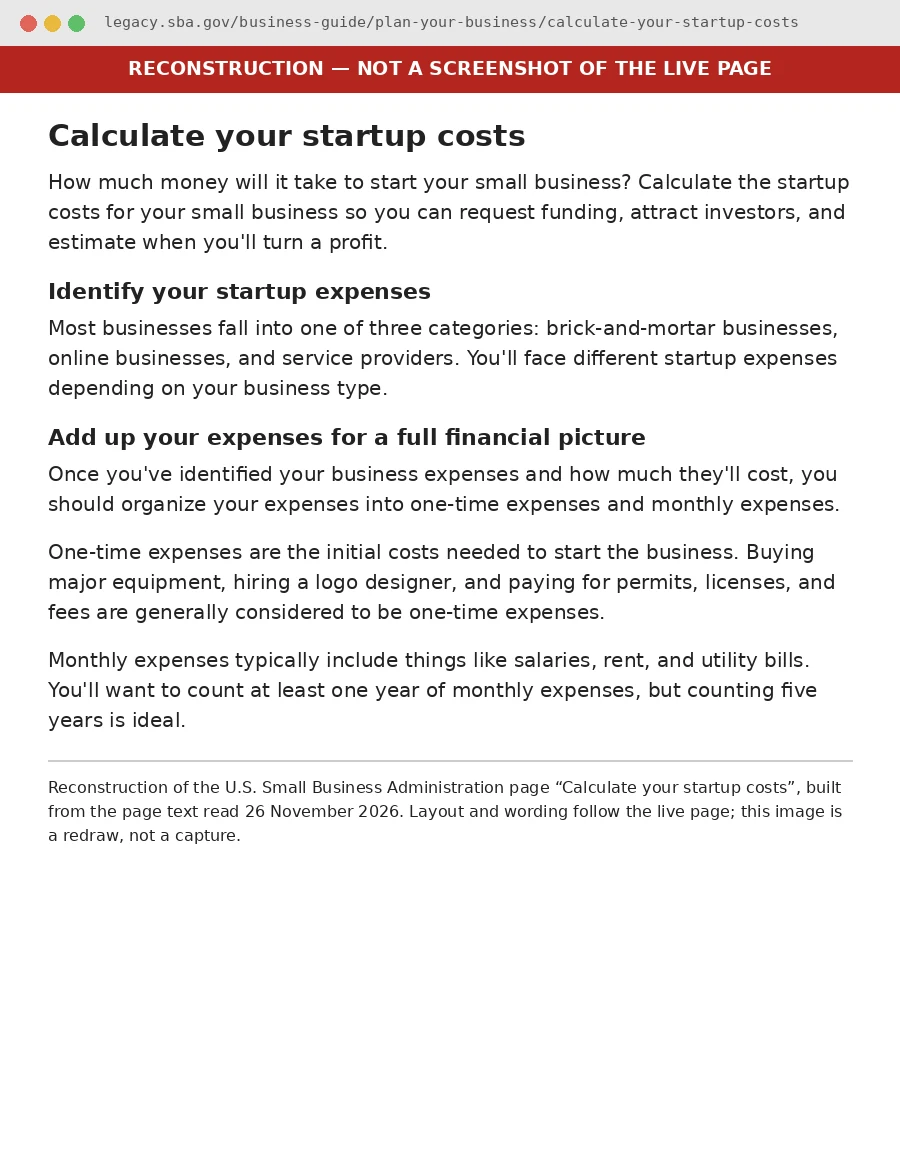
According to the SBA’s startup-cost page, expenses sort into one-time and monthly costs, and at least one year of monthly costs is counted. Reconstruction of the live page, not a screenshot.
Three Budgets, Side by Side
All three budgets below use the same formula.
One-time costs plus monthly costs times runway months plus the emergency fund equals the cash you need.
Every figure is illustrative, built from round numbers so the arithmetic stays visible. Get real quotes for your town and your trade before you commit.
A Solo Service: Garden Cleanup
A service business sells your time, so the launch stays light. Tools and a license dominate the one-time list.
| Cost | Amount (illustrative) |
|---|---|
| One-time: tools and equipment | $450 |
| One-time: license | $100 |
| One-time: website and domain | $120 |
| One-time: first marketing | $180 |
| One-time total | $850 |
| Monthly: fuel | $80 |
| Monthly: supplies | $60 |
| Monthly: phone | $40 |
| Monthly: insurance | $120 |
| Monthly total | $300 |
| Six months of runway | $1,800 |
| Emergency fund: three months | $900 |
| Cash to launch | $3,550 |
Six months of runway plus the emergency fund covers nine months without a sale.
A full year runs higher: $850 plus twelve months at $300 comes to $4,450.
See where each number belongs in the eight-box plan for this business: How to Write a One-Page Business Plan: Eight Boxes, One Evening.
An Online Shop: Digital Templates
An online shop with digital products skips inventory, storage, and shipping entirely. Platform fees and ads become the monthly load instead.
| Cost | Amount (illustrative) |
|---|---|
| One-time: domain | $15 |
| One-time: website setup | $200 |
| One-time: product photos | $150 |
| One-time: registration | $100 |
| One-time total | $465 |
| Monthly: platform | $29 |
| Monthly: email tool | $0 (free tier) |
| Monthly: ads | $100 |
| Monthly total | $129 |
| Six months of runway | $774 |
| Emergency fund: three months | $387 |
| Cash to launch | $1,626 |
Payment fees take a cut of each sale on top of the monthly total.
Price them into every product, as the pricing guide shows: Pricing Your First Product: Simple Math Instead of Guesswork.
Twelve months instead of six runs higher here too: $465 plus twelve months at $129 comes to $2,013.
A Small Storefront: Retail Shop
Rent changes everything, because it starts before the first customer arrives. Build-out and equipment dominate the one-time list, and opening inventory adds thousands more.
Licenses and permits take weeks in some towns, so start them early.
State approval can take days or weeks, the U.S. Chamber of Commerce notes, so file licenses before you sign the lease.
| Cost | Amount (illustrative) |
|---|---|
| One-time: lease deposit | $5,000 |
| One-time: build-out | $12,000 |
| One-time: equipment | $15,000 |
| One-time: opening inventory | $4,000 |
| One-time: licenses | $1,500 |
| One-time: signage | $500 |
| One-time total | $38,000 |
| Monthly: rent | $2,500 |
| Monthly: wages | $3,000 |
| Monthly: utilities | $400 |
| Monthly: insurance | $200 |
| Monthly: supplies | $600 |
| Monthly total | $6,700 |
| Six months of runway | $40,200 |
| Emergency fund: three months | $20,100 |
| Cash to launch | $98,300 |
Nine months of cover costs $98,300 before the first sale. Twelve months costs $118,400, which is why most shops start smaller than this.
| Business | One-time | Monthly | Cash to launch (6 months + fund) | Full year |
|---|---|---|---|---|
| Service | $850 | $300 | $3,550 | $4,450 |
| Online shop | $465 | $129 | $1,626 | $2,013 |
| Storefront | $38,000 | $6,700 | $98,300 | $118,400 |
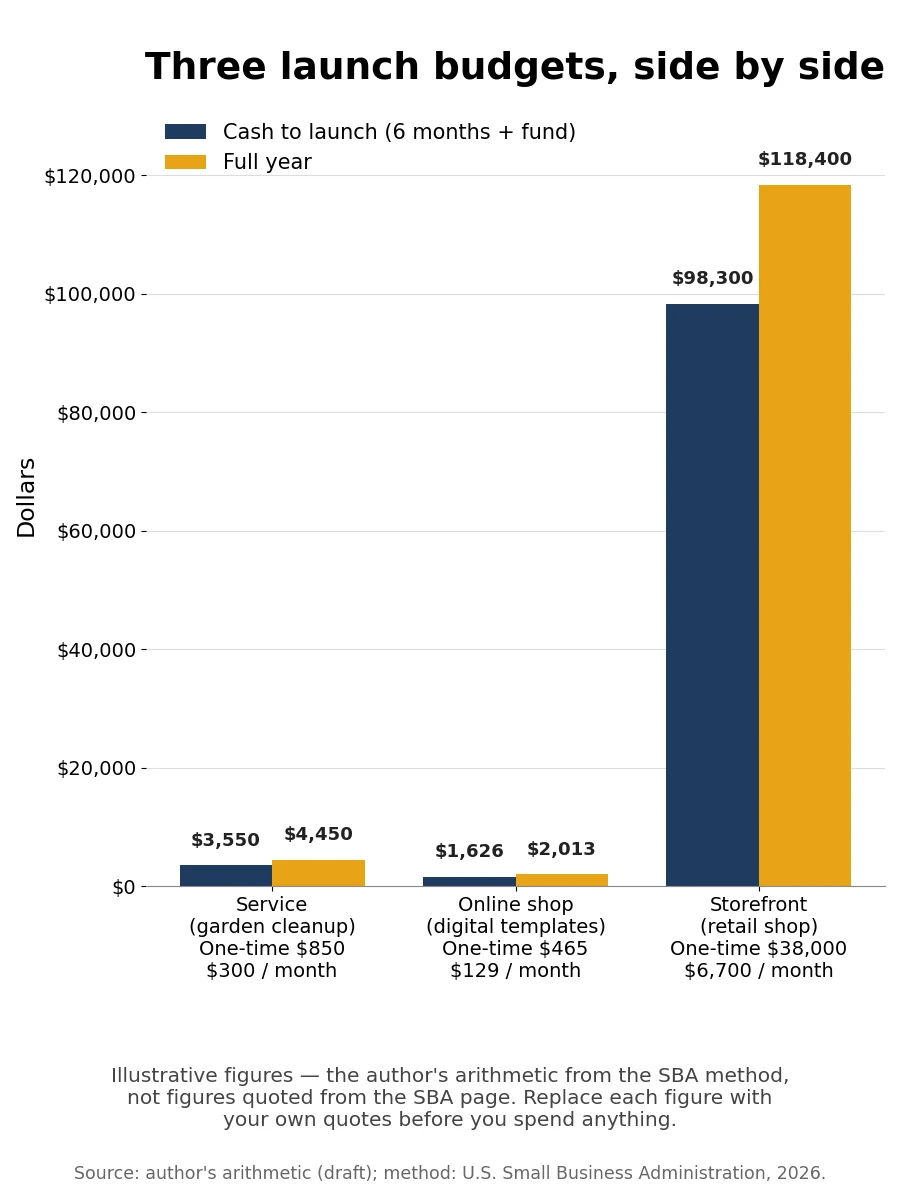
Three launch budgets side by side: a service launch at $3,550, an online shop at $1,626, and a storefront at $98,300. Full-year figures run higher for each.
The Emergency Fund Almost Everyone Forgets
Beginners budget the launch and forget the months after it. Sales rarely cover costs from week one, so the gap needs cash.
Hold three months of monthly costs apart from the runway, and touch it only when sales stall.
Three in four small employer firms felt costs rise in the prior year: 73% (Federal Reserve, 2026).
Profit stayed out of reach for most small employer firms in 2024: only 47% ended the year in the black (Federal Reserve, 2026).
Behind those figures sits the federal survey in our statistics article: Small Business Statistics 2026: Starts, Survival, and the Cost of Staying Open.
Where the Money Usually Comes From
Founders usually pay from their own pockets first.
Cash ran short for many owners, and 54% of firms facing money trouble paid from personal funds (Federal Reserve, 2026).
Borrowing fills the gap for some, but rarely the whole gap.
Fewer than half got everything they asked for: 42% of applicants did (Federal Reserve, 2026).
Fund the launch yourself first, and borrow only to grow it. Rising costs press from day one, so the loan is not the plan.
Read the same warning in the rising-costs news on this site: Rising Costs Hit Three in Four Small US Firms, Fed Survey Finds.
Six Mistakes That Shrink the Budget
- Counting only one-time costs and forgetting the monthly ones.
- Skipping the emergency fund because the launch feels cheap.
- Pricing from hope instead of the cost-plus math.
- Signing a lease before the first sale proves demand.
- Borrowing the full launch cost before any buyer pays.
- Treating the budget as finished instead of updating it monthly.
Tonight, Build Your Budget
Pick your type, list your costs, and run the formula tonight. One page of honest numbers beats a loan application written on hope.
Start with the one-page plan, then let this budget prove the shape can pay: How to Write a One-Page Business Plan: Eight Boxes, One Evening.
Our pillar guide turns the budget into a day of action: How to Start Your Own Business Overnight: A Practical Launch Plan.
This article is general information, not financial advice.
Frequently Asked Questions
What does a service business need to start?
Solo service launches run cheapest in this guide: $3,550, including six months of runway and the emergency fund.
Your town and your tools change the number, so replace each line with a real quote.
Can I start a business with no money at all?
Time is the only cost on day one, as the launch plan shows. Tools, a license, and a domain still need cash before the first sale.
How many months of costs should I save before launching?
Nine months of cover is the cushion in this guide: six of runway plus three of emergency fund.
Count a full year if you can; five years is the ideal the SBA names.
What costs do most beginners forget?
Emergency funds, payment fees, and your own pay top the forgotten list. Insurance renewals and software renewals hide in the monthly column too.
Should I borrow money to start?
Borrow only after the budget proves the business can repay it. Less than half got everything they asked for, so fund the launch yourself first.
Methodology
SBA guidance on startup costs was read directly on 26 November 2026. All budget figures are illustrative, built from round numbers so the arithmetic stays visible.
Federal figures come from our statistics article, which cites the Federal Reserve 2026 report.
Chamber guidance sets the state approval timing used here, read through the pillar article.