

Main image: AI illustration.
Rising costs hit 73% of small US employer firms in the prior twelve months (Federal Reserve, 2026).
Findings come from the Federal Reserve 2026 Report on Employer Firms, based on a survey of 6,525 firms.
Data collection ran from 3 September to 14 November 2025 (Federal Reserve, 2026).
Tariffs Added a Second Squeeze
Tariff-related cost increases reached 42% of firms (Federal Reserve, 2026).
Retailers felt them most at 69%, followed by manufacturers at 62% (Federal Reserve, 2026).
One or both cost pressures touched 77% of firms (Federal Reserve, 2026).
Operating expenses troubled 54%, uneven cash flow 50%, and weak sales 48% (Federal Reserve, 2026).
Debt payments weighed on 33%, and credit availability on 29% (Federal Reserve, 2026).
Only 6% reported no financial challenges at all (Federal Reserve, 2026).
| Pressure | Share of firms |
|---|---|
| Rising costs of goods, services or wages | 73% |
| Tariff-related cost increases | 42% |
| One or both cost pressures | 77% |
| Paying operating expenses | 54% |
| Uneven cash flow | 50% |
| Weak sales | 48% |
| Debt payments | 33% |
| Credit availability | 29% |
| No financial challenges | 6% |
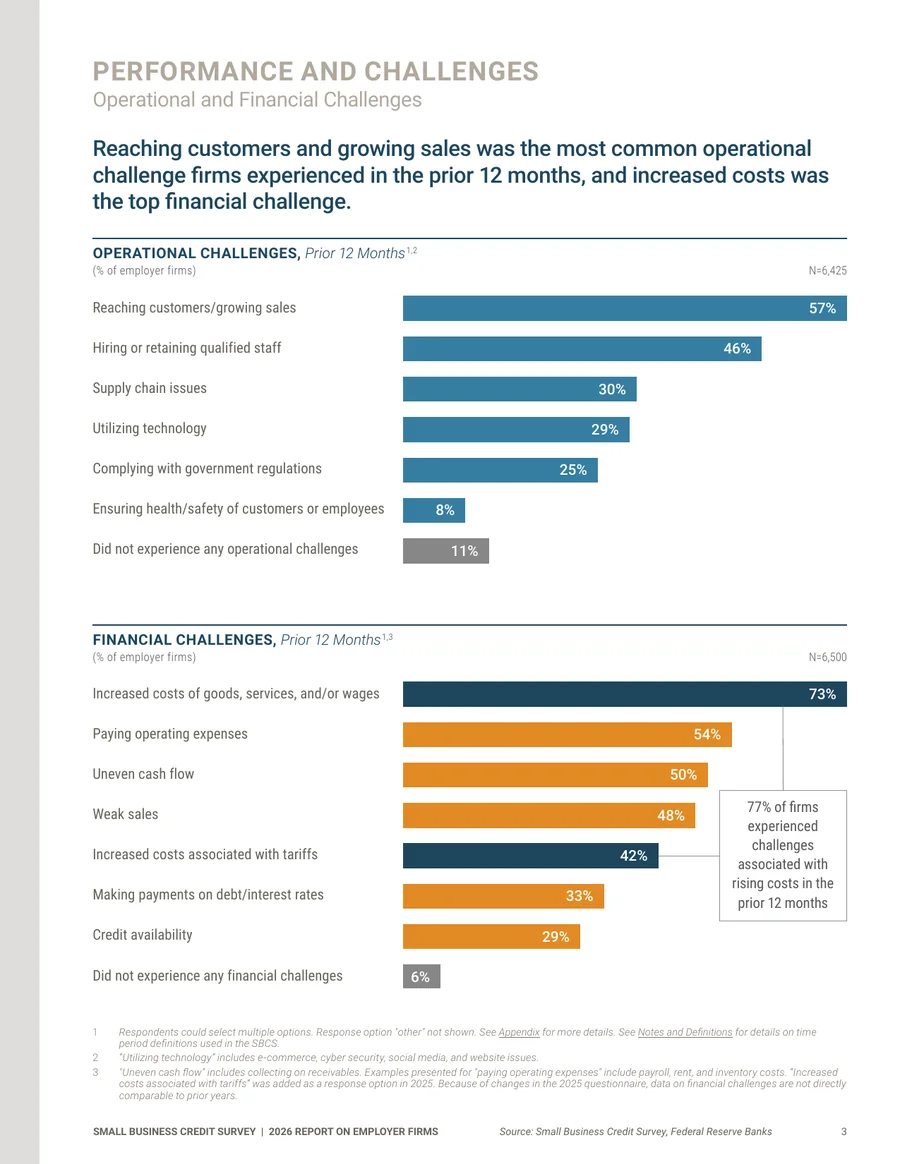
Finding customers and growing sales topped the operational challenges, ahead of every money worry (Federal Reserve, 2026).
Fewer Than Half Were Profitable
Only 47% of firms operated at a profit at the end of 2024 (Federal Reserve, 2026).
Short of cash, 54% of firms with financial challenges dipped into the owner’s personal funds (Federal Reserve, 2026).
Price rises followed at 48%, and new debt at 36% (Federal Reserve, 2026).
Financing was widely sought: 60% of firms applied for some in the prior twelve months (Federal Reserve, 2026).
Meeting operating expenses drove 56% of applicants (Federal Reserve, 2026).
Full Approval Went to a Minority
Full approval reached just 42% of financing applicants (Federal Reserve, 2026).
Some or most of it reached 36%, and 22% received nothing (Federal Reserve, 2026).
The highest full-approval rate sat with small banks: 57%, against 43% at large banks and 38% at online lenders (Federal Reserve, 2026).
Online lenders kept climbing: applications there rose for the fifth straight survey year (Federal Reserve, 2026).
Still, 60% of online-lender borrowers said costs ran higher than expected (Federal Reserve, 2026).
Fewer firms carried debt than in 2020: 31% held none, up from 21% in the 2020 survey (Federal Reserve, 2026).
Still, 38% owed more than $100,000 (Federal Reserve, 2026).
Owners Turned Gloomier
Revenue expectations fell from 39 to 33, and employment expectations from 26 to 23 (Federal Reserve, 2026).
Both expectations hit their lowest point since the 2020 survey (Federal Reserve, 2026).
AI spread fast: 46% of firms used it in some way (Federal Reserve, 2026).
Keep the survey’s caveat in view: the SBCS is a convenience sample, not a random one (Federal Reserve, 2026).
Full context sits in the statistics roundup: Small Business Statistics 2026: Starts, Survival, and the Cost of Staying Open.
Price from costs and margin, not from hope: Pricing Your First Product: Simple Math Instead of Guesswork.
Questions About the Survey
How many firms did the Fed survey?
It collected 6,525 responses from firms with 1 to 499 employees (Federal Reserve, 2026).
Responses were collected between 3 September and 14 November 2025 (Federal Reserve, 2026).
What was the biggest financial challenge?
Rising costs of goods, services, or wages, named by 73% of firms (Federal Reserve, 2026).
Increases tied to tariffs reached 42%, and 77% faced one or both pressures (Federal Reserve, 2026).
How hard is it to get the full loan amount?
Hard: only 42% of applicants received everything they asked for (Federal Reserve, 2026).
Small banks approved fully 57% of their applicants, the highest rate among lender types (Federal Reserve, 2026).
About These Figures
Figures come from the Federal Reserve Banks 2026 Report on Employer Firms, read on 23 November 2026.
The survey is a convenience sample, not a random one, so shares are strong signals, not exact counts (Federal Reserve, 2026).
Tariff costs were a new response option in 2025, so challenge figures are not directly comparable with prior years (Federal Reserve, 2026).