
A one-page business plan fits your whole business on a single sheet of paper. Inside sit the idea, the buyer, the offer, and the numbers.
I write mine after the validation calls, never before them, because a plan written before any buyer says yes is a wish list with boxes.
Summary
- Five conversations and one pre-sale decide what the plan may claim — validation first.
- Eight boxes cover the business: problem, solution, customer, offer, marketing, competitors, numbers, and next steps.
- Each box needs one or two honest sentences, written from evidence rather than hope.
- Banks and investors still want a traditional plan, so this page never pretends to replace one.
- Review the page monthly and rewrite any box the sales prove wrong.
Write It After Validation, Not Before
Most plans fail because they describe a business nobody has tested yet. Yours will describe a business five strangers already reacted to.
Five conversations, one test: our evening validation guide runs it step by step: Validate Your Business Idea in One Evening, Before You Spend Anything.
Bring the notes from those five talks to the page. Every honest sentence below comes from something a buyer said or did.
Without those notes, the boxes fill up with guesses, and guesses look tidy on paper until the first sale tests them.
The Eight Boxes, One at a Time
Start at the top and work down the page in order. A vague problem makes every later box vague too.
101planners asks the same eight questions in plainer form, ending with five dated next steps (101planners, 2026).
1. The Problem
State one painful problem a real person already pays to escape. Skip market sizes here; one named person beats a million imagined ones.
Fit Small Business calls the customer pain point the key question of the whole page.
Picture a homeowner fined by the association for an overgrown yard, paying gladly for someone to fix it this week.
2. The Solution
Describe what you do about the problem in one plain sentence. Leave out features; buyers remember the result, not the tool list.
Take weekly garden cleanup with a photo after each visit, so the owner sees the result without checking the yard.
3. The Customer
Narrow the buyer to one group you could phone this afternoon. Dual-income homeowners in one suburb beat ‘everyone with a garden’.
Suppose your first ten buyers live within three miles, own fenced yards, and work full time.
4. The Offer
Put the offer and its price in plain words. One service at one price beats a menu nobody can choose from.
Imagine a single offer: two hours of garden cleanup at $60 an hour, booked by text message.
Let costs and margin fix the number, and keep hope out of it.
One worked example in the pricing guide runs the same arithmetic on a soap bar: Pricing Your First Product: Simple Math Instead of Guesswork.
5. Marketing
Work two or three free channels every week, and drop the rest.
Word of mouth, a local group, and a simple one-page site cover most solo launches.
Consider flyers in the neighborhood, a post in the local parents group, and a card from each happy buyer.
Buyers without ads: the first-ten-customers guide lists five places to look: Your First Ten Customers: Where to Find Them Without Ads.
6. Competitors
Name the main alternatives your buyer uses today, including doing nothing. Your edge must be one thing a buyer can repeat to a neighbor.
Say the rivals are gardening apps with a different worker each time, plus teenagers from the next street.
7. The Numbers
Put break-even, monthly burn, first-year sales, and startup bill in this box. Mark every estimate clearly; a guessed number beats a blank one only when labeled.
Look at the garden numbers: $300 a month in costs means three $120 jobs cover the month.
The SBA guidance: reserve twelve months of running costs, and five years if you can (U.S. Small Business Administration, 2026).
The companion guide to startup costs breaks the budget down by business type: How Much Money Do You Really Need to Start? An Honest Breakdown.
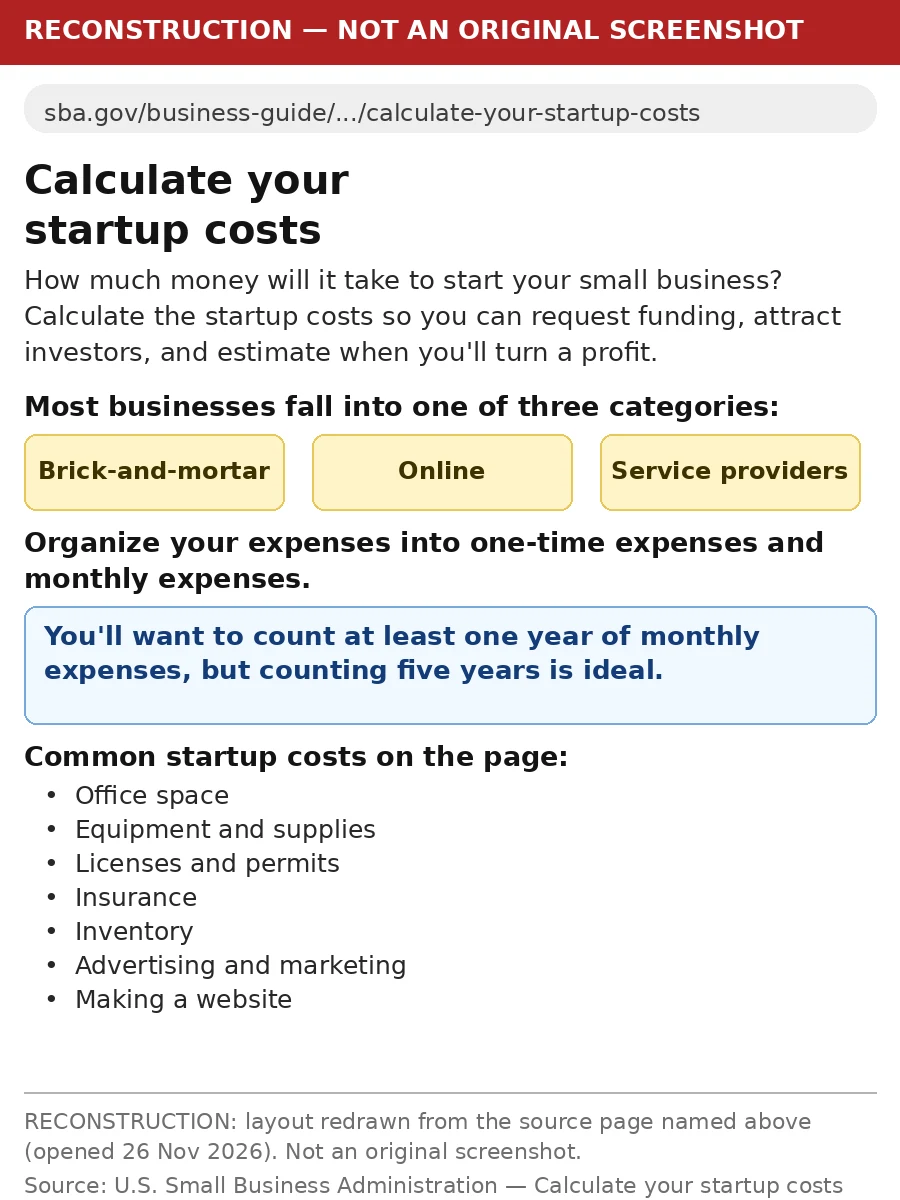
SBA guidance: startups fall into three types, and at least one year of monthly expenses counts.
Source: U.S. Small Business Administration, Calculate your startup costs (reconstruction).
8. Next Steps
Name five next tasks, and put a date beside each one. Tasks without dates are wishes, and wishes do not launch businesses.
Try five dated tasks: call five homeowners, price the job, print flyers, book the first cleanup, ask for a review.
A Filled-In Example: One Page, One Business
Below sits the garden-cleanup plan, filled in from the boxes above. Treat every number as illustrative, and replace it with your own quotes.
| Box | The garden-cleanup plan |
|---|---|
| 1. Problem | Homeowners pay fines for overgrown yards and lack time to fix them. |
| 2. Solution | Weekly cleanup with a photo after each visit. |
| 3. Customer | Dual-income homeowners within three miles, with fenced yards. |
| 4. Offer | Two hours of garden cleanup at $60 an hour, booked by text. |
| 5. Marketing | Flyers nearby, a local parents group, and cards from happy buyers. |
| 6. Competitors | Gardening apps with rotating workers; teenagers from the next street. |
| 7. Numbers | $300 monthly costs; three $120 jobs cover the month, rising to eight jobs a month by year end; first-year sales target $11,520. |
| 8. Next steps | Insure the work, set up booking, print flyers, book the first cleanup, ask for a review. |
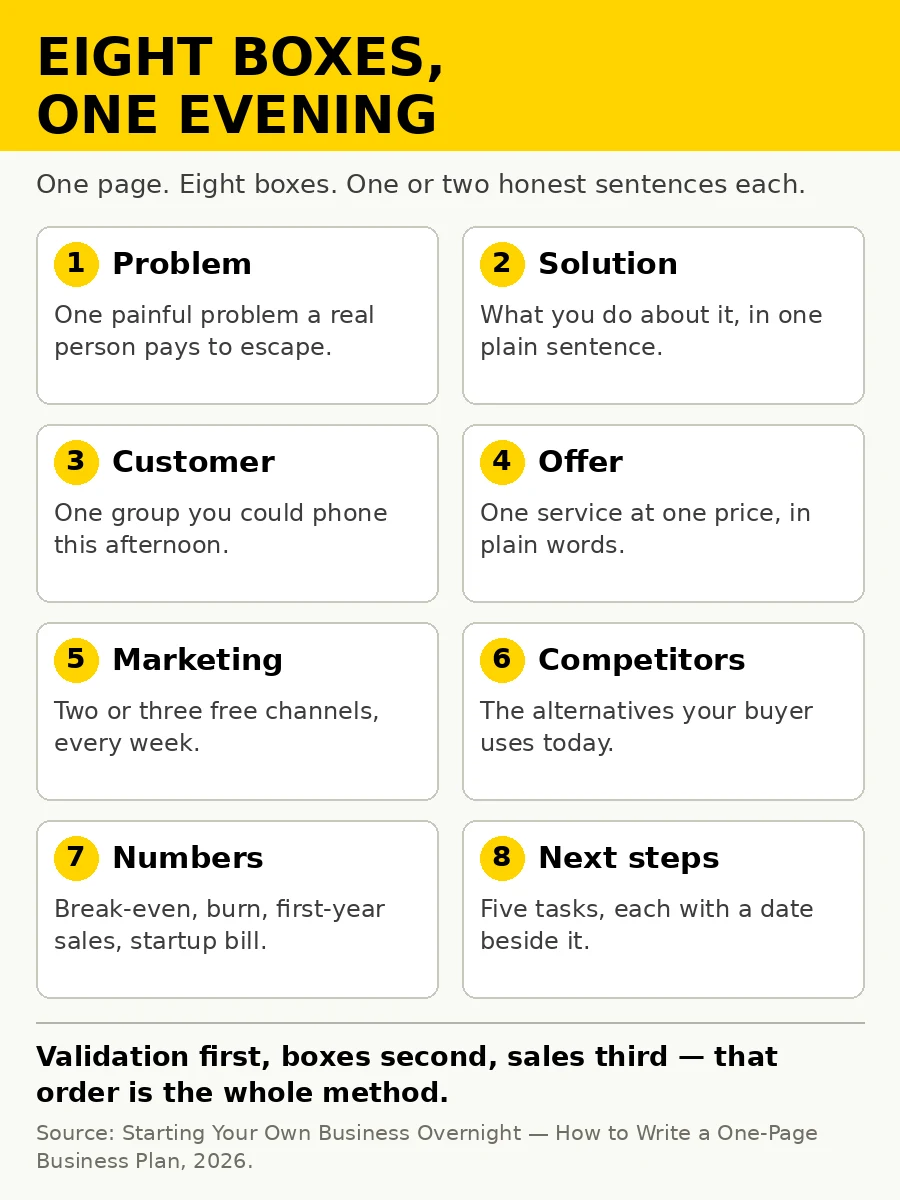
Here are the eight boxes: problem, solution, customer, offer, marketing, competitors, numbers, and next steps.
When One Page Is Not Enough
Banks and lenders ask for a traditional plan with market research and detailed projections.
Fit Small Business states this plainly: funding applications typically require the longer document.
Use the longer plan when a bank, an investor, or a grant asks for one.
Use the one-page version when you fund the launch yourself and need clarity fast.
Oak Business Consultant agrees the one-page format is not a substitute for deep financial modeling when that work becomes necessary.
Smartsheet offers free one-page templates for service, product, startup, and small businesses in Excel, Word, and PDF.
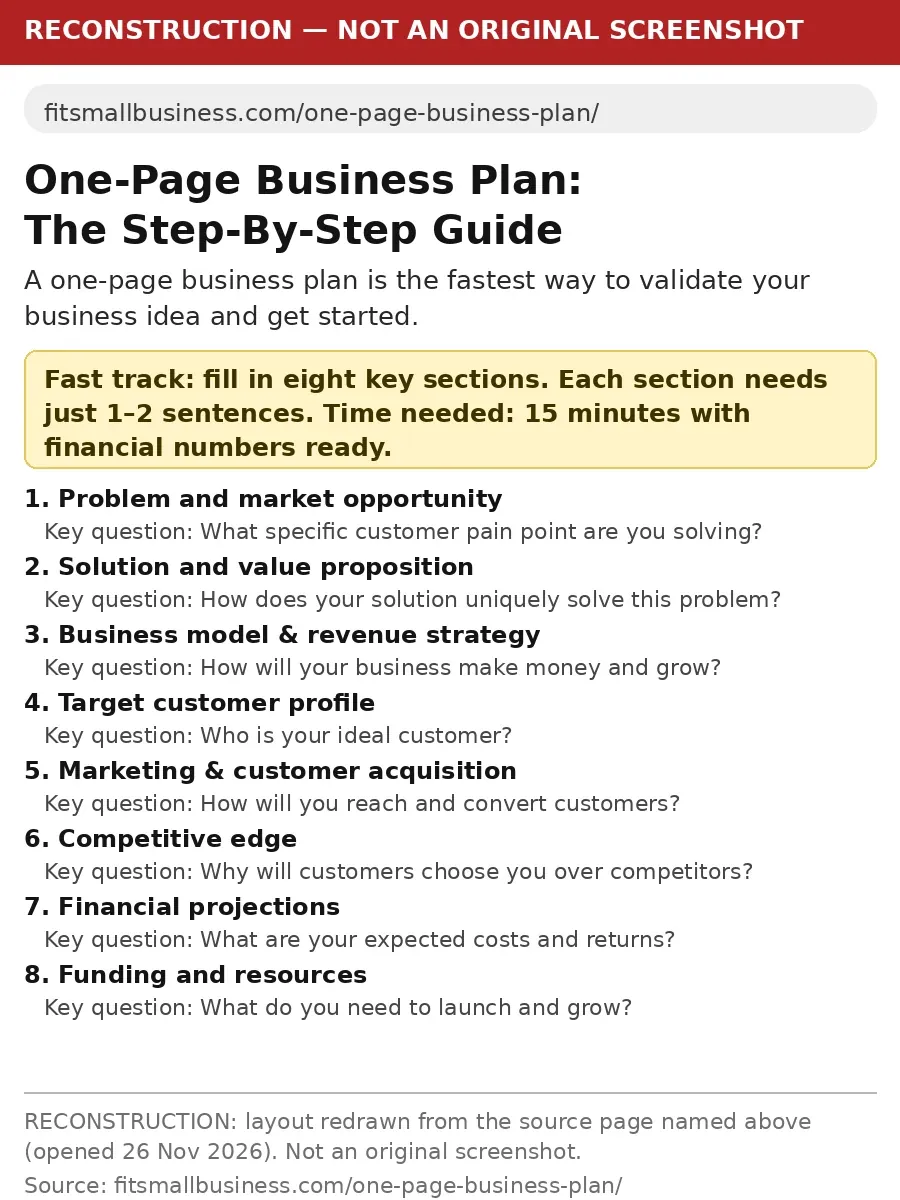
From Fit Small Business: eight sections for a one-page plan, each needing one or two sentences.
Source: Fit Small Business, One-Page Business Plan: The Step-By-Step Guide (reconstruction).
Five Traps That Fill the Page With Fluff
- Writing ‘everyone’ as the customer, which means no one in particular.
- Hiding behind market size instead of naming one buyer.
- Listing features the buyer never asked for.
- Leaving the numbers blank because they feel uncomfortable.
- Filing the page away and never looking at it again.
Keep the Page Alive
Pin the finished page above your desk, where you see it daily. Check the page every month and let the sales rewrite it.
Year-one survival runs at 78.9% for new employer establishments, so the plan that adapts has the better odds (BLS, 2026).
Federal survival curves sit in our statistics article: Small Business Statistics 2026: Starts, Survival, and the Cost of Staying Open.
It holds the other federal numbers behind this guide too.
Tonight, Finish the Page
Validation first, boxes second, sales third: that order is the whole method. Written in that order, the page tells the truth about the business.
Turn the page into a day of action with the launch plan: How to Start Your Own Business Overnight.
Eight boxes, one evening, and one honest page: that is enough to start.
Frequently Asked Questions
How long does a one-page business plan take to write?
Fifteen minutes covers it with financial numbers ready (Fit Small Business, 2026). Gather the numbers first, and the writing stays quick.
Do I need a business plan before I validate my idea?
Validate first, then write the plan from what buyers told you. Plans written before validation guess at the customer, the price, and the problem.
Can I use this plan to apply for a bank loan?
No, a bank usually asks for a traditional plan with detailed projections. Keep the one-page version for yourself and build the longer document for the lender.
What if I cannot fill in one of the boxes?
Leave it blank and write the question that would fill it. An empty box marks the next conversation, not a failed plan.
How often should I update the plan?
Revisit the page monthly and after every ten sales. Change the boxes the sales prove wrong, and keep the ones they confirm.
Methodology
Direct reads on 26 November 2026 covered Fit Small Business, 101planners, and the SBA startup-costs page.
Oak Business Consultant and Smartsheet were verified from indexed copies of their pages the same day.
Garden-cleanup figures in the example are illustrative, built from round numbers for arithmetic rather than quoted from any seller.
Behind the federal figures sits the Bureau of Labor Statistics release for 2026, via our statistics article.