

Sunlight falls on a registration form and its stamp. Beside it, a laptop shows a checklist with every box ticked.
“Registering a business” sounds like one form.
It is four different filings, and the order matters.
File them in the wrong order and you pay twice, wait twice, or file the tax ID under a name that does not exist yet.
In 2025, business applications hit 5,696,742 — a record for any year (Census Bureau, 2025).
Most of those filers went through the same four steps below.
Nothing here is legal or tax advice — read it as general information.
Money and business decisions deserve a qualified professional’s advice.
Summary
- Registration is four filings, not one: the entity, the trade name, the tax ID, and local licenses.
- Pick the legal structure first, because it decides what you file and where.
- Form the entity with your state before applying for its federal tax ID.
- IRS issues the EIN free — never pay a website for one.
- Licenses and permits come from the city, county, state, or federal level, depending on the trade.
Four Filings, Not One
Each filing does a different job, and none of them covers the others.
| Filing | What it does | Where | Cost |
|---|---|---|---|
| Entity | Creates the legal business, if you form one | Secretary of State | Varies by state |
| Trade name (DBA) | Lets you trade under a name that is not your legal name | State, county, or city | Varies by place |
| EIN | Gives the business its federal tax ID | IRS, online | Free |
| Licenses and permits | Lets you legally sell what you sell, where you sell it | City, county, state, or federal | Varies by trade |
Sole proprietors trading under their own legal name skip the first two filings entirely.
Everyone else files at least the entity and the tax ID, and most file a trade name too.
Read the four steps in order below, and do not skip ahead.
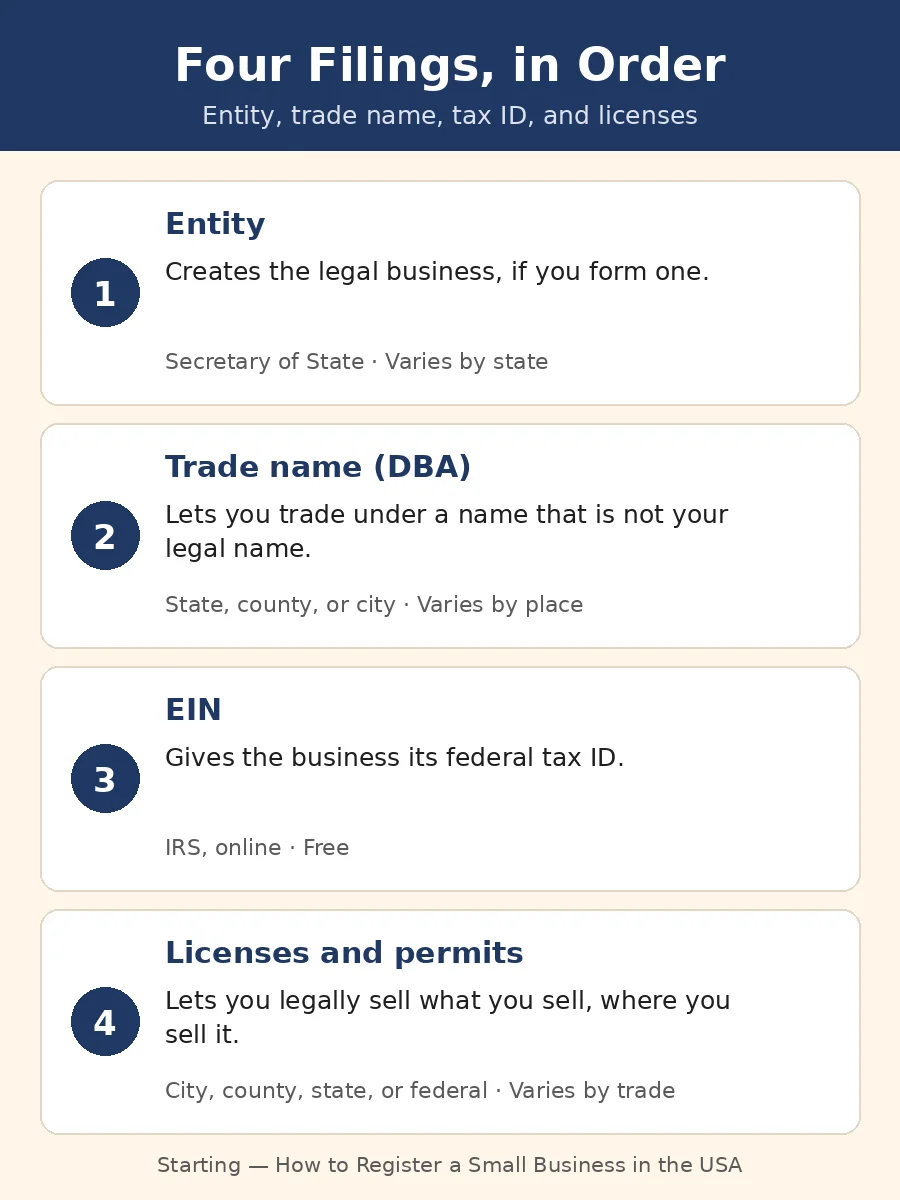
Four filings in order: entity, trade name, tax ID, and licenses. Every card names the office and the cost.
Step 1: Choose the Structure
Structure comes first because it decides every filing after it.
SBA lists five common structures, and the choice changes liability, taxes, and paperwork (SBA, 2026).
Trading as yourself: you are the business, with no separate entity and no state filing.
Partnership: two or more owners together, with a written agreement behind it.
LLC: a separate entity that shields personal assets in most cases, with profits passing through to your personal return.
Corporation: the strongest protection, the heaviest records, and the highest formation cost.
S corp: a corporation that elects pass-through taxation, filed separately with the IRS.
Low risk and modest assets point to a sole proprietorship for day one.
Higher risk or real assets point to an LLC, once the state filing is done.
Pick the structure before you file anything, because the state asks for it on the first form.
Step 2: Check the Name
Check the name before you file it, not after.
Search your state’s business name registry first.
Names already registered in your state usually get refused, and the search costs nothing.
USPTO Trademark Search comes next, at tmsearch.uspto.gov.
Similar marks in the same field can conflict, even with different spelling (USPTO, 2026).
Look at the domain name last, and match it to the business name exactly.
Buyers type what they hear, so a mismatch sends them elsewhere.
Our naming guide runs all three searches step by step: Choosing a Business Name That People Remember and Can Spell.
A DBA goes on file if you trade under any name other than your legal name.
The filing is required in most states, and a DBA plus an EIN lets you open a bank account under the business name (SBA, 2026).
Step 3: Appoint a Registered Agent
LLCs, corporations, partnerships, and nonprofits need a registered agent in their state (SBA, 2026).
Agents receive legal papers for the business — service of process, tax notices, and state letters all go to the agent’s address.
You can serve as your own agent in most states, if you keep a street address in that state and stay reachable in business hours.
Hiring a service costs a yearly fee and keeps your home address off public filings.
Agents are unnecessary for sole proprietors, because no separate entity exists to receive papers.
Name the agent on the formation form, before you file it.
Step 4: File With the State
Filing with the state creates the entity.
LLCs file articles of organization; corporations file articles of incorporation.
File online through your Secretary of State, and keep the stamped confirmation.
Approval takes days or weeks, depending on the state (U.S. Chamber of Commerce, 2026).
Launch the selling part while the filing waits, and formalize the rest next.
Filing fees vary by state and by structure, so ask your Secretary of State before you budget.
Sole proprietors trading under a personal legal name need no state paper at all.
That shape starts the moment business begins, with no state paper at all.
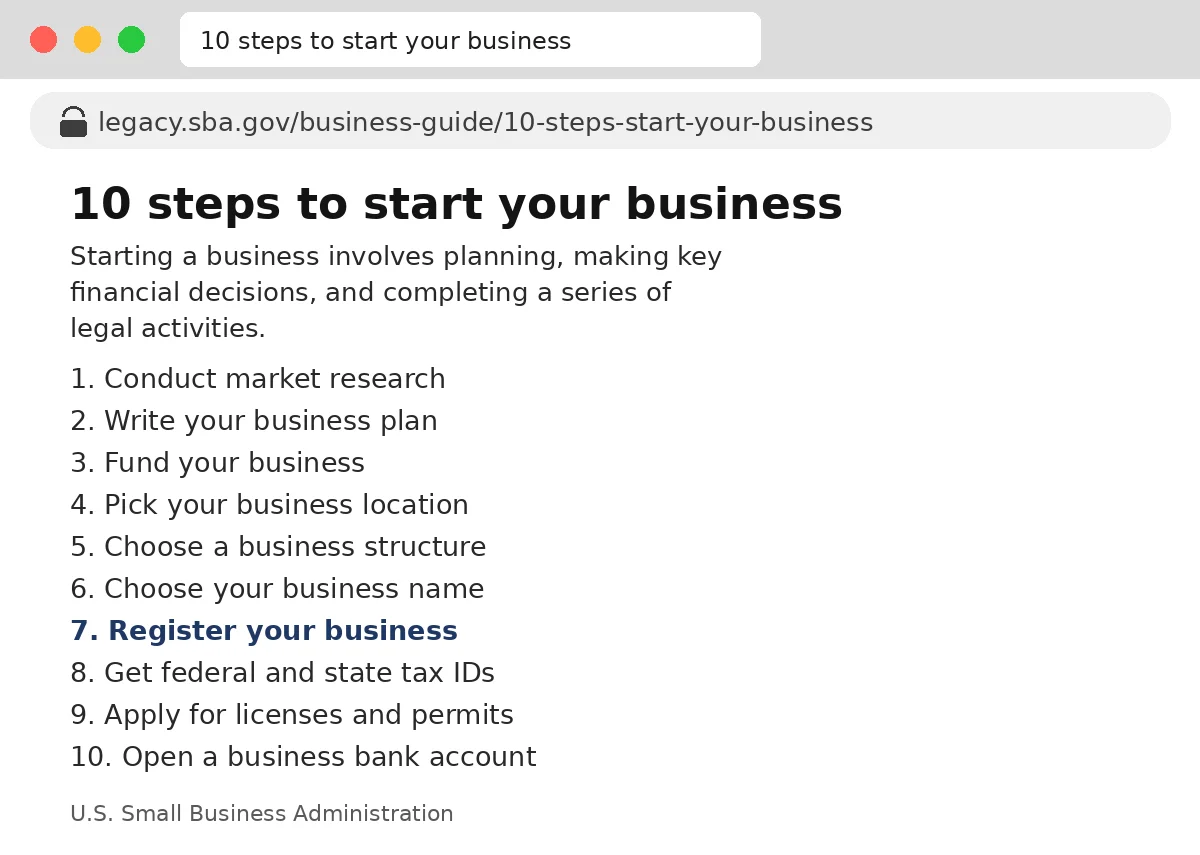
Ten steps run from market research to a bank account. Step seven is the registration itself.
Step 5: Get the EIN
An EIN identifies the business to the federal government for tax purposes.
Online, the IRS issues it free in one sitting.
Finish the form without a long pause — the IRS session ends after 15 idle minutes (IRS, 2026).
No website should ever charge you for one.
An EIN is always free — the IRS says so plainly (IRS, 2026).
Get the state filing done before you apply for the EIN.
IRS warns that applying first can delay the application (IRS, 2026).
Whoever runs the business must have a Social Security number or ITIN on hand.
Employees, partnerships, and corporations all need one, and many banks ask for it to open a business account.
No staff means a sole proprietor can often skip the EIN.
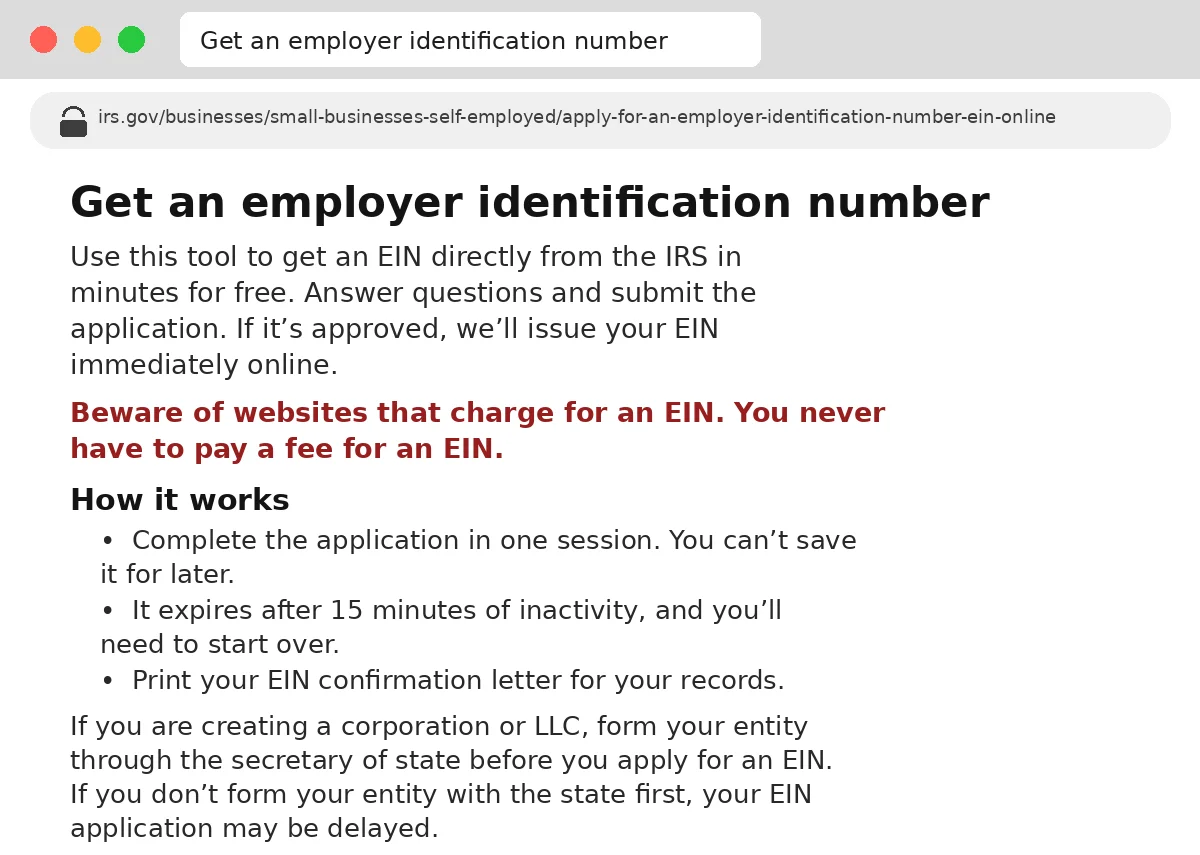
Minutes and free: the IRS issues the EIN online. Never pay a website for one — the page says so plainly.
Step 6: State Taxes and Licenses
Federal registration does not cover state taxes or local licenses.
Register for a state tax ID through your state government, in a process similar to the federal one (SBA, 2026).
Steps vary by state, so read your state government’s pages before you file.
Your trade and your place decide which licenses and permits you need.
Federal, state, and local permissions mix together for most small businesses (SBA, 2026).
Read the rules for your city and state ahead of your first sale.
A food seller, a contractor, and an online seller face three different license lists.
What It Costs
Registration is cheap for a solo start, and the only fixed price is zero.
| Item | Cost | Note |
|---|---|---|
| Sole proprietorship | $0 | No filing when trading under your own name |
| EIN | $0 | Free from the IRS, always |
| State entity filing | Varies | Check your Secretary of State |
| Trade name (DBA) | Varies | State, county, or city |
| Licenses and permits | Varies | Depends on your trade and place |
| Registered agent service | Yearly fee | Optional if you serve as your own agent |
Budget the state filing first, because it is the only fee you cannot avoid when forming an entity.
Everything else on the list is either free or optional at launch.
What Can Wait Until After the First Sale
Not every filing belongs on launch day.
Trademark filing can wait — but the trademark search cannot, because a conflicting mark can force a rename.
Multi-state registration can wait until you actually sell in a second state.
S corp election can wait until the business earns enough for the tax math to matter.
Business credit, payroll accounts, and hiring paperwork all wait until the business has sales and staff.
Sell first, then formalize the parts that only matter once money flows.
Sell today and let the paperwork follow at the state’s pace: How to Start Your Own Business Overnight: A Practical Launch Plan.
Record applications show the scale of the rush: US Business Applications Hit a Record 5.70 Million in 2025.
New businesses usually start alone: 36.2 Million Small Businesses in the US, and Four in Five Have No Staff.
Methodology
Steps in this guide follow the SBA’s ten-step launch guide and its pages on structures, names, and bank accounts, read on 25 November 2026.
EIN rules come from the IRS application pages, read the same day.
Business application totals come from the Census Bureau’s Business Formation Statistics.
State approval times follow the U.S. Chamber of Commerce guide to starting a business fast.
Fees are stated as varying by state, because no single figure covers all fifty states.
Judgment, not measurement, stands behind the launch-day sequence: it is the author’s order, chosen so no filing blocks the next one.
Everything here assumes a launch in the United States.
Readers abroad should run the same four steps and check the official registration and tax pages in their own country.
Frequently Asked Questions
Do I need to register my business at all?
Trading under your own legal name as a sole proprietor needs no registration, and you can still sell.
Forming an LLC or corporation, or trading under another name, does need state filings.
How long does registration take?
Days or weeks for state approval, while the EIN arrives in one online sitting and licenses vary by trade.
Start selling as a sole proprietor while the state filing waits.
How much does it cost to register a small business?
The EIN costs nothing, and a sole proprietorship needs no filing fee.
State entity filings, trade names, and licenses vary by state, so check your Secretary of State before you budget.
Can I get an EIN before forming my LLC?
Form the entity with your state first, because applying early can delay the application.
That order comes straight from the IRS pages on EINs (IRS, 2026).
What happens if I skip the licenses?
Selling without a required license risks fines and a forced stop, even when the business itself is registered.
Check the rules first, because a warning usually arrives after the first sale, not before.
References
- 10 steps to start your business, U.S. Small Business Administration
- Choose a business structure, U.S. Small Business Administration
- Choose your business name, U.S. Small Business Administration
- Get an employer identification number, Internal Revenue Service
- Business Formation Statistics, U.S. Census Bureau
- How to Start a Business in a Few Hours, U.S. Chamber of Commerce