

A shop sign carries the new business name. Short, plain words pass the telephone test and the radio test.
Your name does three jobs before you sell anything.
It tells a stranger what you do, it sticks in memory after one hearing, and it survives a search without confusion.
Business applications reached 5,696,742 in 2025 — the most in any year yet (Census Bureau, 2025).
In a crowd that size, plain names go fast, so check before you fall in love with one.
This guide covers choosing and checking a name, not filing a trademark.
For legal questions about a name, consult a qualified attorney.
Summary
- Say the name once on the phone: if the listener cannot spell it, buyers will not find it.
- Short beats clever: two or three plain words outlast a pun that needs explaining.
- Run three free searches before printing anything: the state registry, the USPTO trademark database, and the domain.
- Registering a name with your state is not the same as owning it as a trademark.
- Change a bad name before the first business card, not after the first customer.
Say It Once, Spell It Once
Two tests decide most names in under a minute.
Telephone test: say the name once on a call, then ask the listener to spell it back.
Radio test: hear the name once, with no spelling shown, then write it down from memory.
Pass both and the name works in the real world, where buyers hear it before they read it.
Fail either and the name leaks customers every day.
Every misspelling is a buyer who lands on someone else’s page.
Shortlist three names, then run both tests on five people who have never seen them written down.
Strangers give honest results; friends guess what you meant.
Write down exactly what each person spelled, not whether they got it right.
Two wrong spellings out of five means the name fails, however much you like it.
Short Beats Clever
Length is the first filter, not the last.
Three words or fewer fit on a card, in a search box, and in a spoken sentence.
Four words still work if each one is plain.
Five words start to disappear from memory before the sentence ends.
Plain words beat clever ones for a new business.
“Clear Cut Lawns” tells a buyer more in three words than “The Verdant Edge” does in a paragraph.
Puns need explaining, and explaining costs the sale.
Words buyers already know travel further than words they must learn.
Say the name out loud five times fast.
Stumbles, tongue twisters, and awkward sounds all show up before the fifth repetition.
Drop any word that needs a spelling lesson.
Your name should survive a noisy room, a bad connection, and a tired listener.
The Three Free Searches
Three free searches come before any money changes hands.
Each one catches conflicts the others miss, so run all three.
Begin at the registry where your state lists business names.
Most states refuse a name already registered there, and the search costs nothing.
Second, search the USPTO Trademark Search system at tmsearch.uspto.gov.
It replaced the old TESS database in November 2023, and searching it needs no account (USPTO, 2023).
Search the exact name, then close variants: misspellings, plurals, joined words, and sound-alikes.
Marks need not match exactly to conflict; similar in sound, look, or meaning can block you (USPTO, 2026).
Live marks are the ones that can block a registration, so filter for those first.
Dead records matter less, but the owner may still use the name, so note them too.
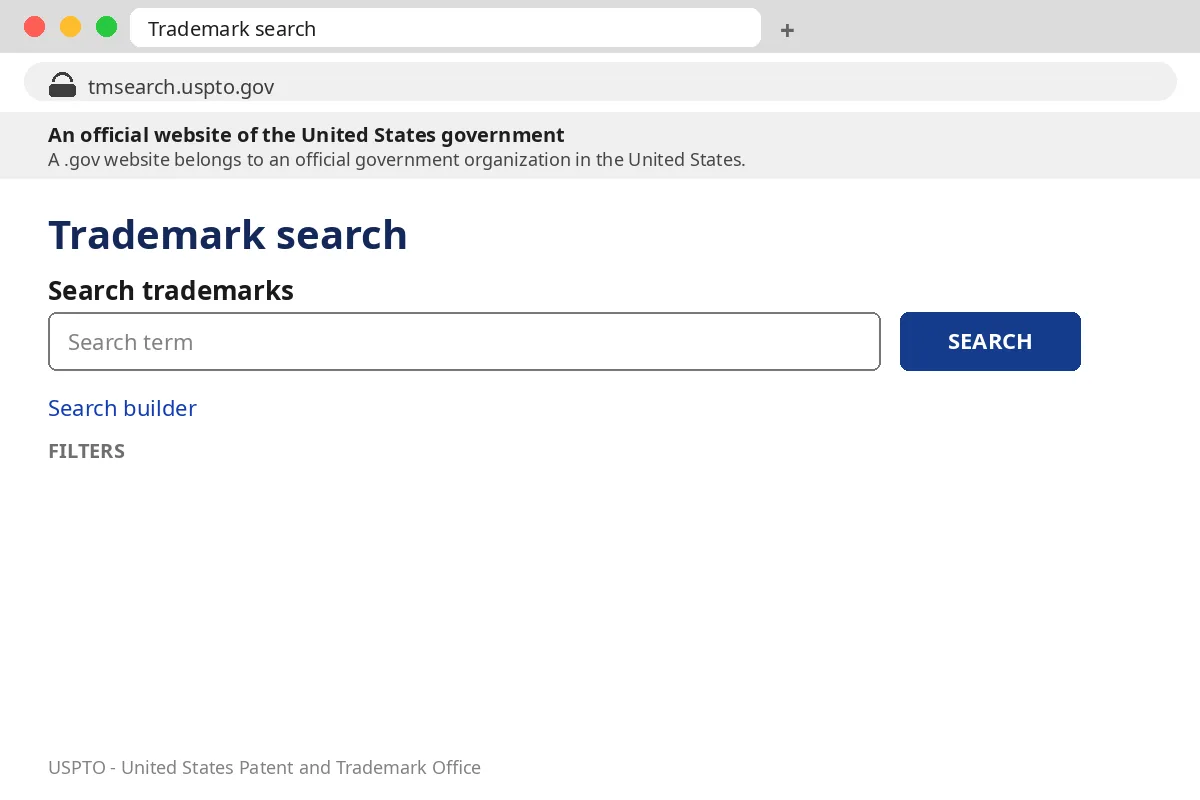
This page opens straight to the USPTO search box. No sign-in stands between the reader and the search.
Third, search the domain name and the social handles.
Match the domain to the name exactly, because buyers type what they hear.
Check the .com first, since buyers guess it by habit.
The USPTO received 767,138 trademark filings in fiscal year 2024 (USPTO, 2024).
With that many filings, a quick search is not caution — it is the cheapest step in the whole launch.
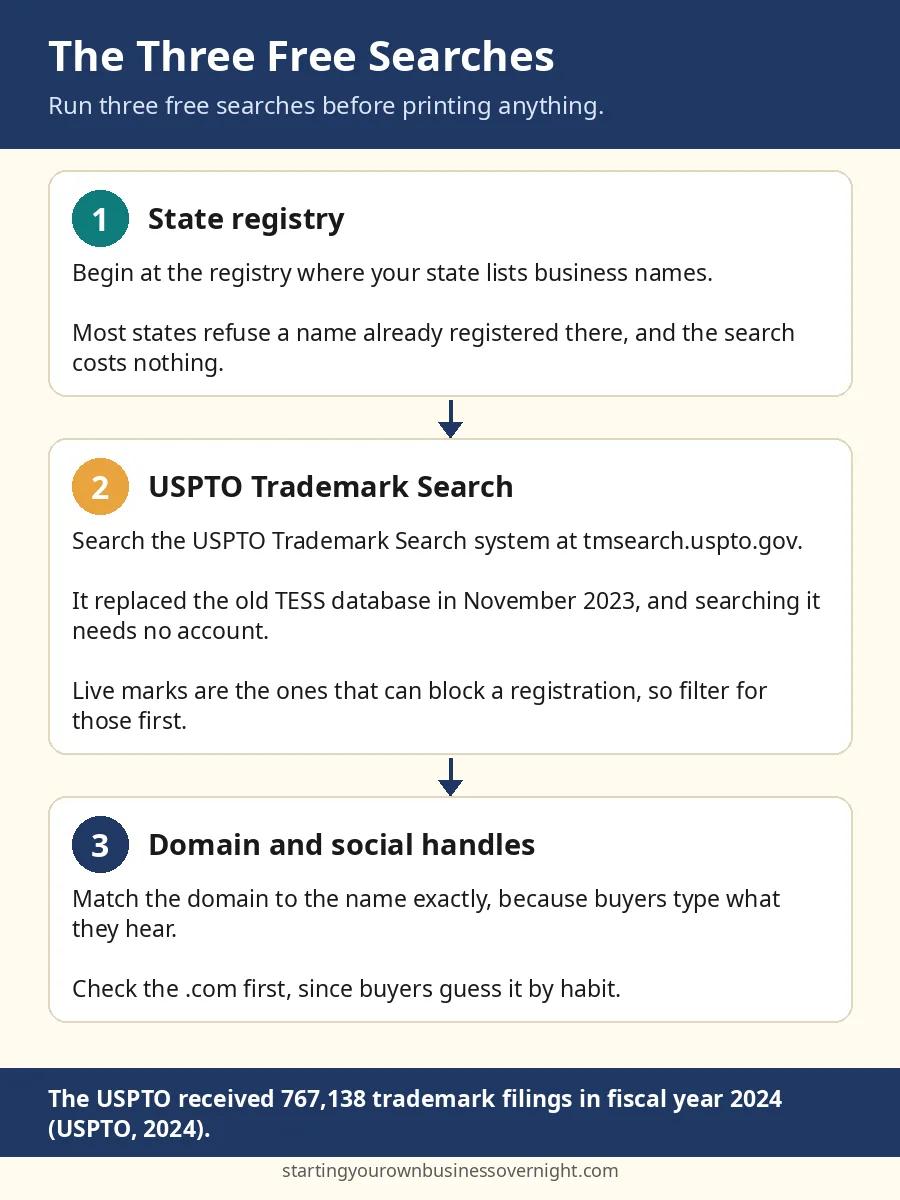
Run the three searches before printing anything. Every search catches a conflict the others miss.
Four Ways to Register the Name
Registering a name means four different things, and the SBA lists all four.
Each filing guards a different thing; no single filing covers them all.
| Way | What it protects | Where you file |
|---|---|---|
| Entity name | The legal name of your LLC or corporation, inside one state | Secretary of State |
| DBA (trade name) | The public name you trade under, if it differs from the legal name | State, county, or city |
| Trademark | The name as a brand, nationally, for your goods or services | USPTO |
| Domain name | The web address buyers type | A domain registrar |
File the entity name when you form an LLC or corporation.
State rules decide whether a sole proprietor must register anything at all.
Operating under your own legal name usually needs no filing (SBA, 2026).
Register a DBA if you trade under any other name.
Most states require the filing, and banks open a business account on a DBA plus an EIN (SBA, 2026).
Filing a trademark is a separate step, and it is the only one of the four that protects the name nationally.
Never assume one filing covers the rest.
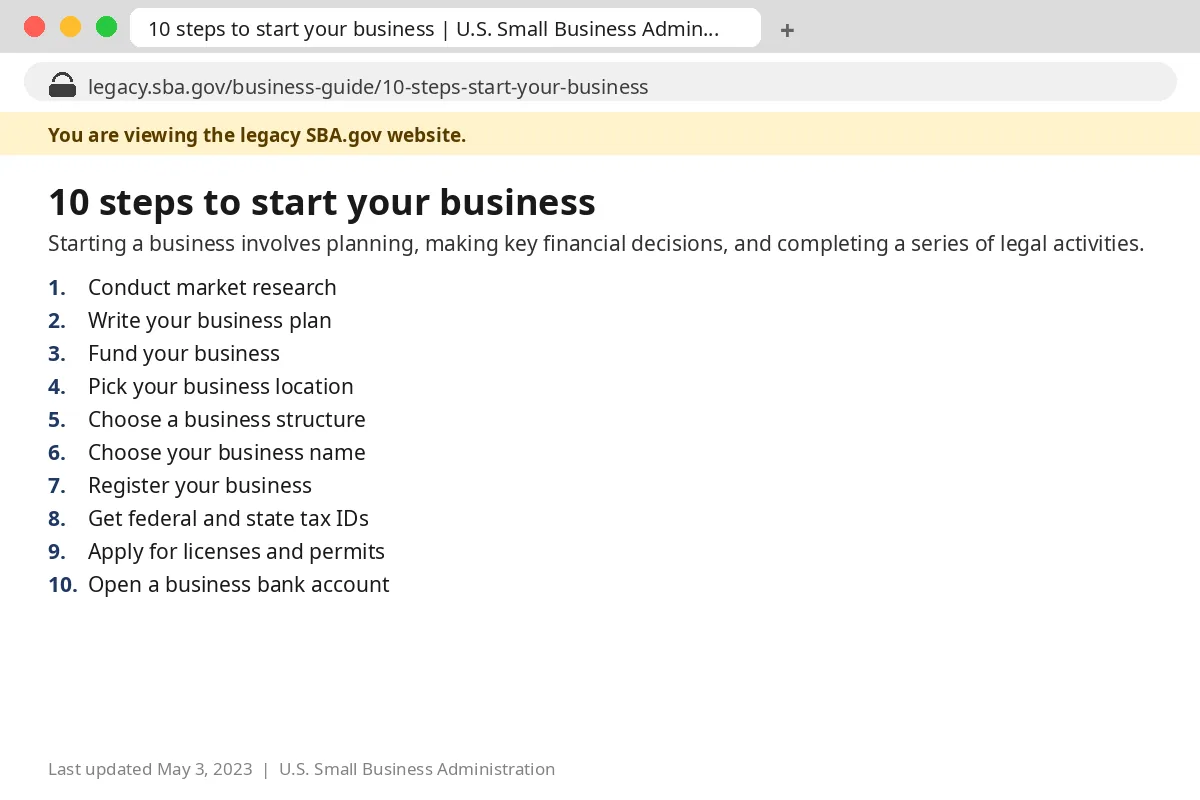
SBA lists ten steps for starting a business. Choosing a business name is step six.
Names That Cause Trouble
Some names cause trouble long after launch day.
Generic words are the first trap.
“Best Pizza” describes every pizza shop, and no one remembers which one you mean.
Geography is the second trap.
A name tied to one town stops fitting the day you serve the next town.
Hard spellings are the third trap.
Creative letters — “Kwik,” “Xtreme,” “Lite” — fail the radio test on the first hearing.
Names that box you in are the fourth trap.
“Bob’s Lawn Care” fits until Bob adds pressure washing, and then the name fights the business.
Copying a famous name is the worst trap of all.
Similar names in the same field invite a legal letter, even when the spelling differs.
When to Change a Name
Change a name early, while it costs nothing.
Before the first card, the first sign, and the first customer, a name is just words on a list.
After the first customer, a name is a reputation, and changing it costs both.
Keep a name that passes the two tests and the three searches, even if it feels plain.
Plain names warm buyers up; clever names shrink on first contact.
Drop a name that fails a search, however long you have loved it.
Love does not survive a trademark letter.
The launch plan puts naming beside the domain and the site: How to Start Your Own Business Overnight: A Practical Launch Plan.
Name the business after the idea is validated, not before.
That evening guide runs the test first, before a dollar goes out: Validate Your Business Idea in One Evening, Before You Spend Anything.
Methodology
Our figures come from two official sources, read on 25 November 2026.
USPTO filing totals come from the agency’s fiscal year 2024 data, and the Trademark Search system replaced TESS in November 2023.
Census Bureau’s Business Formation Statistics is the source for the application totals.
Registration steps follow the SBA’s guide to choosing a business name and its ten-step launch guide.
Judgment, not measurement, stands behind the telephone test and the radio test: both come from naming practice, not from a study.
Registries named here are American, and so is the launch this guide covers.
Frequently Asked Questions
Can I use a business name someone else already uses?
Not safely in the same field — similar names can conflict even with different spelling, and the state registry may refuse yours outright.
Search all three databases first, then pick a name with a clear field.
Is registering with my state the same as a trademark?
State registration protects the name inside one state, while a federal trademark protects it nationally for your goods or services.
File a trademark separately if the name matters to the brand.
Must I file a trademark before selling?
You can sell first and file later — but search first, because a conflicting mark can force a rename after customers know you.
Early searching costs nothing; a late rename costs the reputation.
What if the .com domain is taken?
Pick another name, not another ending, when the .com belongs to a business in your field.
Buyers guess .com by habit, and a look-alike domain sends them to the other business.
How long should a business name be?
Aim for two or three plain words; four still works if each word is plain.
Five words start to disappear from memory before the sentence ends.