
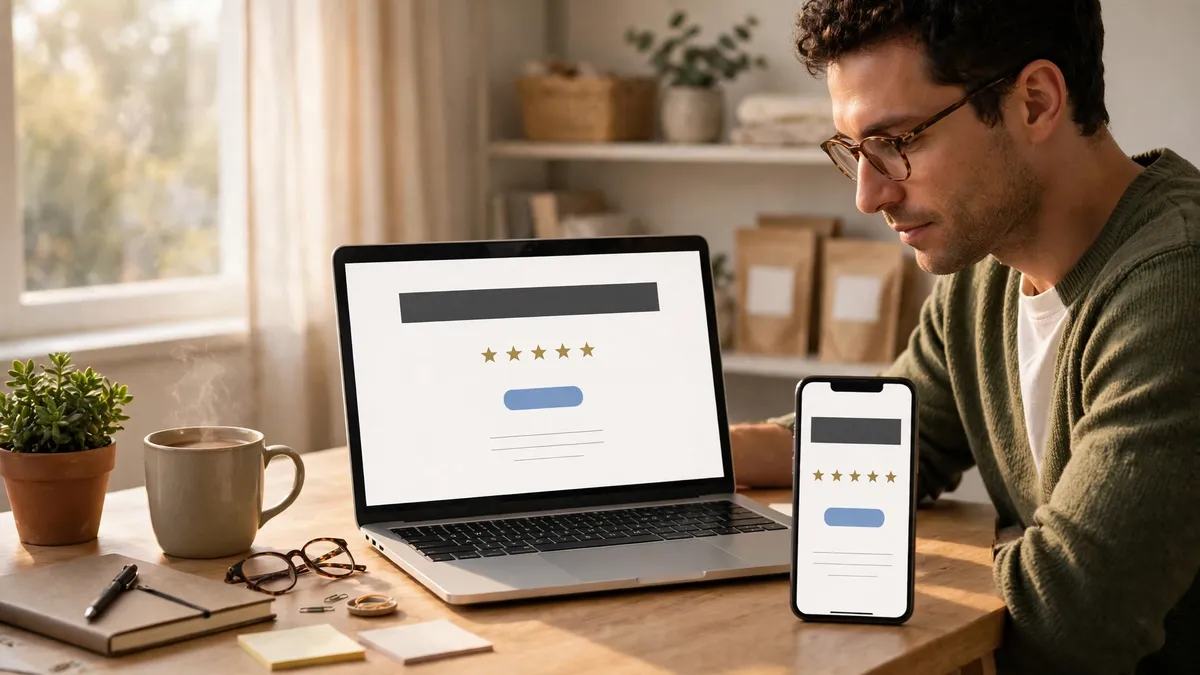
One page on a laptop and a phone, with the offer, the proof, and one button in view.
A visitor decides fast.
Three quarters of consumers pick a business in under 30 minutes, and more than a quarter decide in under five (BrightLocal, 2026).
Your page has one job in that window: answer three questions in order.
Most one-page sites fail the first question.
They open with a slogan, a stock photo, and a menu — and never say what the business sells.
Keep the page to one screen of selling and one screen of proof.
Everything else is a distraction that costs you the visitor.
Summary
- A one-page site answers three questions in order: what you sell, why buyers can trust you, and what to do next.
- 84% of consumers searched online for a local business in the last three months (BrightLocal, 2026).
- 73% of those searches started on a mobile phone (BrightLocal, 2026).
- Proof beats adjectives: reviews, a price, and a way to pay do more than any slogan.
- Leave out every block that answers none of the three questions.
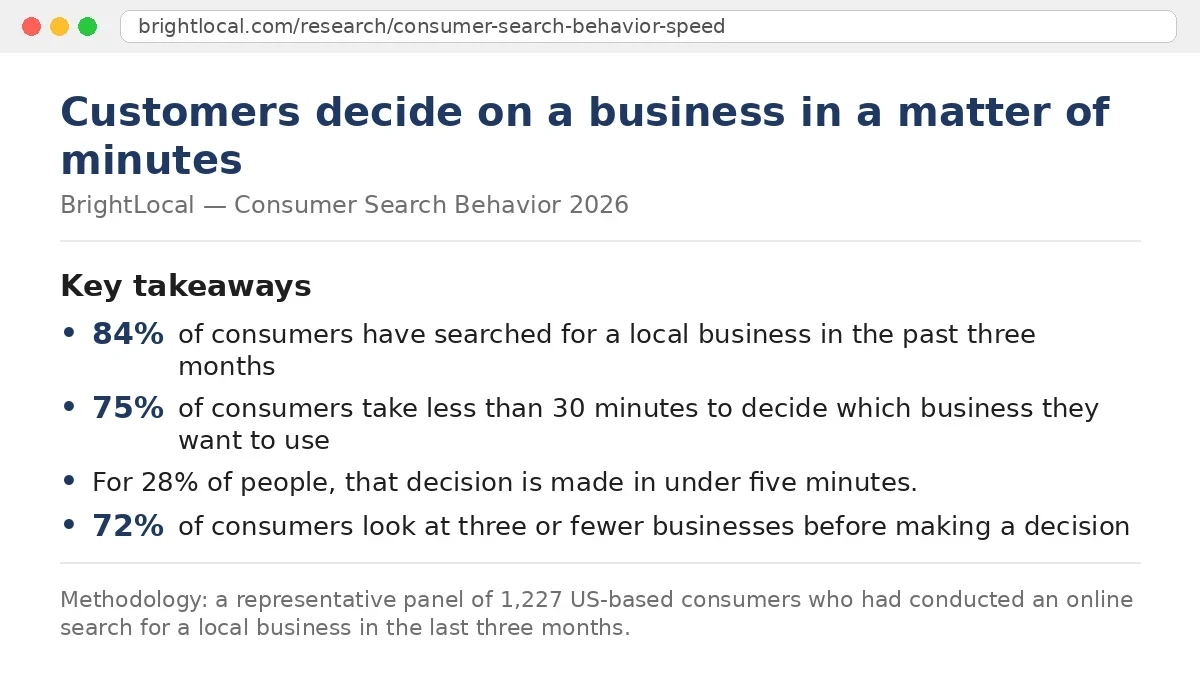
BrightLocal’s speed research: 84% searched online, 75% decided in under 30 minutes. Its survey covered 1,227 US consumers.
The Three Questions in Order
Every visitor arrives with the same three questions, in the same order.
First: what do you sell, and for whom?
Second: can I trust you with my money?
Third: what do I do next?
Answer them out of order and the visitor leaves at the first gap.
Put the offer at the top, the proof in the middle, and the action at the bottom.
| Question | What the visitor needs | Where it sits |
|---|---|---|
| What do you sell? | The service, the buyer, the price | Top of the page |
| Can I trust you? | Reviews, real work, a real face | Middle of the page |
| What do I do next? | One button, one phone number | Bottom — and top |
Seven in ten consumers look at three or fewer businesses before deciding (BrightLocal, 2026).
Your page is not competing with the whole internet.
It is competing with two other pages, and the clearest one wins.
What Goes Above the Fold
Above the fold means what a visitor sees before scrolling.
Four things belong there, and nothing else does.
Name the service and the buyer in the headline.
“Garden cleanup for busy homeowners in Austin” beats “Welcome to GreenCare Solutions” every time.
Follow it with one sentence of offer: what the buyer gets, and what it costs to start.
Put the price or the starting price up front, then one button: call, book, or buy.
Phone numbers belong as text, not inside an image.
Visitors on phones should tap the number and reach you.
The Six Blocks That Earn the Sale
Six blocks carry the whole page.
Each one answers one of the three questions, and each one earns its place or goes.
| Block | Job | Keep it if |
|---|---|---|
| Offer | States the service, the buyer, the price | It fits in two sentences |
| Proof | Reviews, testimonials, photos of real work | It names a real buyer |
| How it works | Three steps from first contact to done | A stranger can follow it |
| About the seller | One photo, two lines, one credential | It answers “who is this?” |
| Questions | Three questions buyers actually ask | Each answer is two sentences |
| Contact and payment | Phone, email, payment link | A buyer can pay from the page |
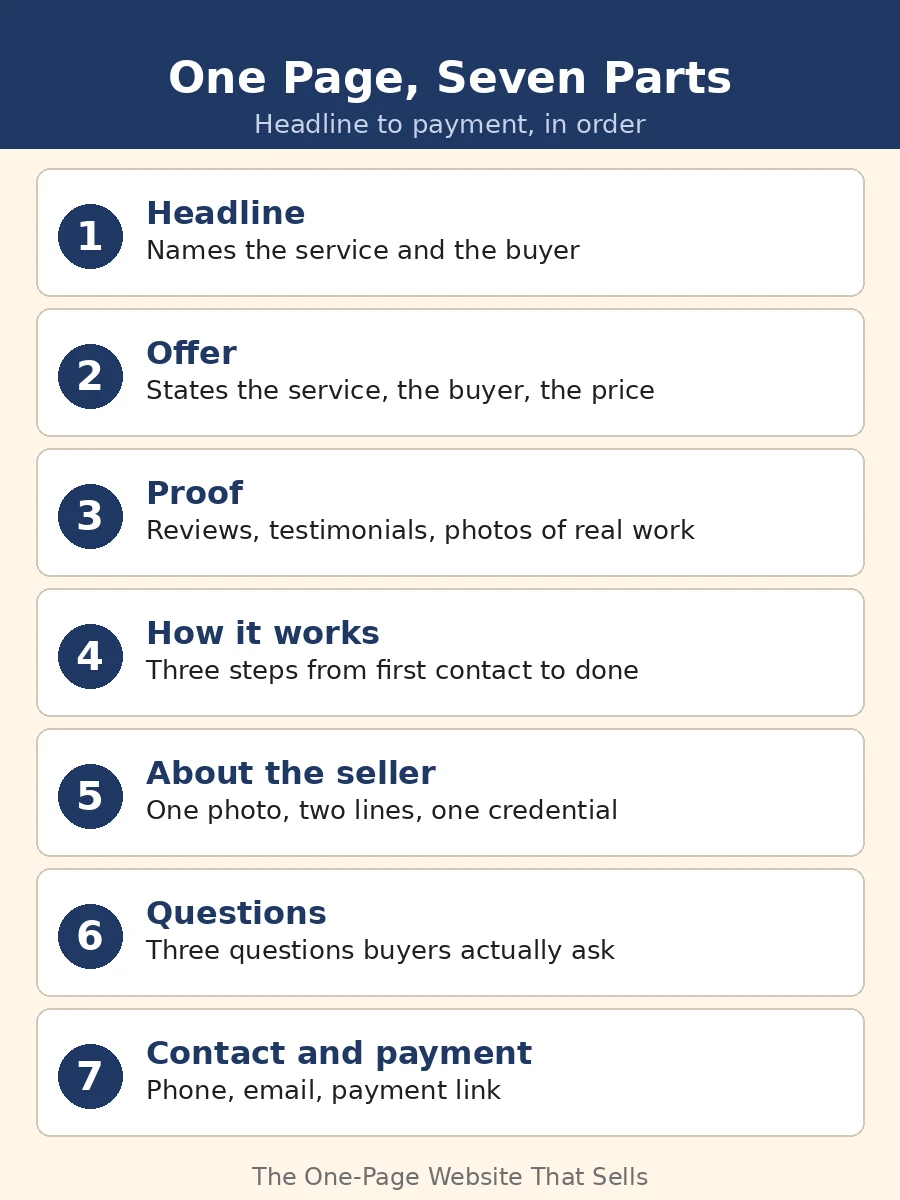
Seven parts carry the page from headline to payment. All seven answer one of the three questions.
Validation comes first in the evening guide, before the offer sentence: Validate Your Business Idea in One Evening, Before You Spend Anything.
Let the work and materials behind the offer set the charge: Pricing Your First Product: Simple Math Instead of Guesswork.
Proof Without a Portfolio Yet
New businesses have no portfolio, and buyers know it.
Reviews close that gap faster than anything else a new seller can build.
97% of consumers read reviews for local businesses, and 41% read them every time they look (BrightLocal, 2026).
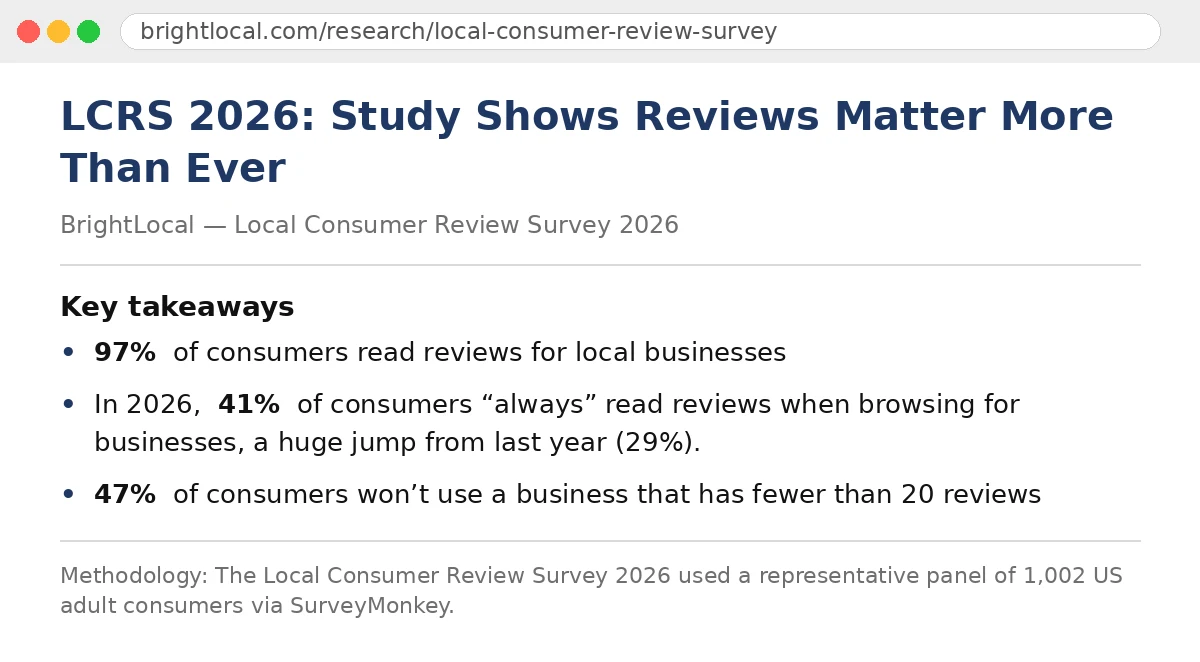
Nearly every buyer reads reviews before choosing a business: 97% do, and 41% do it every time. Its panel covered 1,002 US consumers.
After positive reviews, 54% visit the business website as their next step (BrightLocal, 2026).
Reviews are the bridge between search and your page, not a decoration on it.
Ask your first buyers for a short testimonial while the work is still fresh.
The first-ten-customers guide shows where those buyers come from: Your First Ten Customers: Where to Find Them Without Ads.
Real work in a photo beats a stock photo every time.
Buyers can tell the difference in a second, and a stock photo tells them nothing about your work.
Keep the price visible, even a starting price.
Hiding it reads as expensive, and the visitor leaves to find a number elsewhere.
What to Leave Out
One-page sites fail by addition, not by subtraction.
Each block below answers none of the three questions, so leave it out.
- Mission statements about your passion for excellence.
- Company histories nobody asked for.
- Stock photos of handshakes and smiling teams.
- Blog links with two posts from last year.
- Newsletter popups that appear before the offer does.
- Autoplay videos that talk over the visitor.
- Five service pages hiding behind a menu.
Cut one block and the page gets clearer.
Cut three and the page starts selling.
The Mobile Test
Most of your visitors arrive on a phone.
73% of recent local business searches started on a mobile device (BrightLocal, 2026).
Build the page for that visitor first, then check it on a computer.
Run the thumb test: headline, button, and phone number all reachable without stretching.
Tap the phone number yourself and confirm it dials.
Read every line on the small screen.
If a sentence wraps to four lines, shorten it to two.
Few images mean the page loads fast and scrolls cleanly.
Heavy pages lose the visitor before the offer appears.
Launch It in an Afternoon
Build the whole page in one afternoon, in this order.
- Write the offer sentence: what you sell, for whom, at what starting price.
- Pick the headline: service plus buyer, no slogan, no welcome.
- Add the price and the button: one action, one phone number.
- Add one testimonial: a real buyer, a real sentence, a real name.
- Test it on your phone: thumb, tap-to-call, two-line sentences.
- Send it to five people: ask what it sells and what to do next.
- Fix the first confusion: whatever they got wrong is the first edit.
This page goes up in the late-morning block: How to Start Your Own Business Overnight: A Practical Launch Plan.
Ship the page when five strangers can answer the three questions from it.
Polish comes after the first sale, not before it.
Methodology
BrightLocal’s 2026 consumer research supplies the figures in this guide, read on 25 November 2026.
Consumer Search Behavior 2026 surveyed 1,227 US consumers who had searched for a local business in the last three months.
Local Consumer Review Survey 2026 surveyed 1,002 US adults on a representative panel, published 11 February 2026.
Percentages here are shares of those survey panels, not of all Americans.
No measurement stands behind the block order or the afternoon checklist: both are the author’s judgment from how the surveys describe buyer behavior.
Survey panels here are American consumers, and the launch in this guide is American too.
Frequently Asked Questions
Do I need a website at all on day one?
Yes, one page is enough — buyers search online first, and a page with an offer beats a social profile with no price.
The full multi-page site can wait until the business has paying customers.
What should the headline say?
Name the service and the buyer in plain words, with no slogan and no welcome.
“Garden cleanup for busy homeowners in Austin” tells a visitor more than any clever line.
How many reviews do I need before the page works?
Start with a single real testimonial, and add more as they arrive.
47% of consumers will not use a business with fewer than 20 reviews (BrightLocal, 2026), so keep asking every buyer.
Should the page show prices?
List at least a starting price, because hiding it reads as expensive.
Buyers who cannot find a number leave to find one elsewhere.
Can one page rank on Google?
Focused pages can rank for their own service and town, and a Google Business Profile helps buyers find them.
Ranking is a later job; selling to the visitors you already reach comes first.