

Gambar utama: Ilustrasi AI.
The website is live, the offer is ready, and no replies have arrived yet. That empty inbox does not mean the idea is wrong.
Most new businesses start without an audience. First sales usually come from direct conversations, not from a crowd.
This article is general information, not financial advice. For decisions about your money, consult a qualified financial adviser.
Summary
- Known contacts offer the fastest start for your first ten customers, because trust already exists.
- Discussion groups reveal the problem in the buyers’ own words, while local visibility builds trust in person.
- Partner introductions borrow trust from a business buyers already know.
- Satisfied buyers complete the set, and each place trades proof against time in a different way.
Your first ten customers try your offer while it is still new. From them, you learn what works and whether the problem matters enough for someone to pay.
Without ads, you can still reach them, approach them with respect, and turn early interest into a first sale.
Begin from the home page of Starting Your Own Business Overnight. Build on the careful thinking you used to test the idea in the first place.
If you have not tested the idea yet, read Validate Your Business Idea in One Evening, Before You Spend Anything before you look for buyers. With a clear offer, every conversation gets easier, because people can quickly decide whether it fits a problem they already have.
Start With People You Already Know
Often, the earliest buyers are people you already know, or people one step away from them. Former colleagues, neighbours, friends of friends, and group members can be genuine first buyers when the offer fits a need they already have.
Start with a short list of people who have the problem you solve, rather than a long list of everyone you know. Such a list keeps the work focused, and it helps you notice who responds with real interest instead of polite encouragement.
Starting with people you know suits a new offer with a clear problem and a small circle of contacts. It suits a product aimed at strangers less well, because personal contacts may not share the problem.
Make the List From Real Problems, Not From Contacts Alone
Write down the problem first, then write the names of people who have mentioned that problem in ordinary conversation. That order matters, because it stops you from offering a service to people who have no reason to buy it.
Think about recent conversations where someone described a task they disliked, a delay they wanted to avoid, or a result they wanted sooner. Those moments are useful clues, and they give you a natural reason to follow up.
Ask for a Conversation, Not for a Favour
Ask for a short conversation about the problem, and explain what you offer in one clear sentence. People can then decide for themselves, and the answer tells you something useful whether they buy or not.
Avoid asking friends to buy simply because they know you, because that kind of sale teaches you little about the offer. Genuine first customers buy because the offer helps them, and that reason is what you can repeat with strangers later.
Go Where the Problem Is Already Being Discussed
The people who could become those first buyers are already talking about the problem somewhere, even if they have never heard of your business. Look for the places where people ask questions, share frustrations, and look for recommendations in their own words.
Online groups, local noticeboards, community pages, and hobby forums can all work when the group already discusses the topic. Choose the place where the problem appears often, not the one with the largest number of members.
Groups suit an offer where people already discuss the problem in their own words. They suit a problem people rarely mention in public less well, because there is little conversation to join.
Listen Before You Offer Anything
Read recent questions and replies before you post anything about your offer. You will learn the words people use, the options they have already tried, and the details that matter most to them.
Listening also protects your reputation, because a thoughtful reply stands out in a group full of quick promotions. When you understand the conversation, your offer can fit into it naturally instead of interrupting it.
Answer Questions With Useful Detail
Answer a question fully, even when the answer does not lead directly to a sale. Clear answers show that you understand the work, and they give the reader a reason to remember you when they need help.
End with a simple next step, such as an invitation to send a message if the problem sounds familiar. Compared with a long sales message, that simple invitation works better, because it respects the reader and keeps the conversation private.
Make the First Step Small and Clear
Make the first step small and clear, because a stranger will not commit to a large purchase from a business they have just found. Short trials, single sessions, starter packages, and clearly defined first tasks lower the risk for both sides.
Describe exactly what the buyer receives, when they receive it, and what happens next. Clear boundaries build trust, and they make it easier for the buyer to say yes without needing to ask for more detail.
Name the Result, Not Only the Service
People buy a result they can picture, such as a finished room, a working website, a tidy garden, or a plan they can follow. Name that result in plain language, and keep the description of your process short.
When the result is clear, the buyer can compare it with the problem they already have. Comparing the result with the problem is the real decision, and it happens faster when you remove extra detail.
How the First Step Is Usually Priced
First steps are usually priced for what they actually include, with the price explained in the same place as the offer. Buyers should not need to guess the cost, because guessing creates doubt and delays the reply.
Lowering the price too far can make the work hard to deliver well. In practice, a small first step often carries a price that reflects the time it takes.
Pricing this way suits a service with a clear first step that a buyer can judge quickly. It suits open-ended work less well, because the first step is harder to define.
Use Your Local Area Before You Go Wider
Your local area is practical for finding your first ten customers: distance is short, trust builds easily, and neighbours can see good results. Nearby buyers can meet you, see your work, and recommend you to someone nearby.
Local work also gives you faster feedback, because you can see the result in person and ask the buyer what they noticed. Feedback gathered this way is valuable while the offer is still new, and it helps you improve before you reach a wider audience.
Local work suits a service delivered in person or in a small area. Online offers gain less from it, because distance brings no advantage.
Be Present Where Local People Look for Help
Noticeboards, community centres, local markets, school groups, and neighbourhood chats are places where people already look for a reliable local service. Short, honest notices work well when they state the service, the area you cover, and how to contact you.
Keep the notice simple and easy to read from a distance, because a busy reader will only give it a few seconds. Stating the service, the area, and the contact method clearly is enough to start a conversation.
Offer Help in Person When It Fits the Work
Some offers are easier to explain in person, especially when the buyer wants to see a sample or ask a question first. Brief visits or short meetings can answer those questions faster than a long exchange of messages.
Keep the meeting short and focused on the buyer’s problem, and bring only what helps them decide. Calm, prepared conversations build more trust than long presentations.
Borrow Trust Through Partnerships
Partnerships can introduce you to your first ten customers, because the partner already has the trust of people who need your offer. Look for a business that serves the same kind of buyer with a different service, so the two offers fit together without competing.
For a partnership to work, it needs a clear benefit for the partner and for their customers. Both sides understanding the benefit makes the introduction feel helpful rather than forced.
Good partnerships start where buyers overlap: the partner’s customers already have the problem you solve. They suit a new offer with no clear match less well, because the partner has little reason to recommend it.
Choose Partners Whose Customers Match Yours
Choose a partner whose customers already have the problem you solve, and whose service comes before or after yours in a natural order. Matching customers make the introduction easy to explain, and they give the partner a reason to recommend you.
Talk to the partner first about how they work and what their customers value. What you learn there helps you shape an offer that fits their customers, instead of asking them to promote something they do not understand.
Make the Introduction Easy for the Partner
Give the partner a short description they can use in one or two sentences, and a simple way for a customer to contact you. Partners are more likely to help when the task takes little time and the message is easy to share.
Thank the partner for each introduction, and tell them how the conversation went when the customer agrees to share that detail. Partnerships grow when both sides can see that the introductions are handled with care.
Turn One Customer Into the Next One
One happy customer can lead to the next one, because a personal recommendation carries more weight than a description on a website. Ask for a recommendation only after the work is finished and the buyer is satisfied with the result.
Make the request specific, such as asking whether they know one person with the same problem. Specific requests are easier to answer than general requests to tell everyone, and they respect the buyer’s time.
Ask What Changed for the Buyer
Find out what changed for the buyer after the work was done, and listen to the answer in their own words. Their description often explains the value of the offer more clearly than your own description does.
Use what you learn to improve the offer and the way you describe it. Their words can show you which part of the result mattered most, and that part deserves a clear place in your next conversation.
Referrals suit a buyer who is satisfied with a visible result. A first step with no visible result gains less from them, because the buyer has little to describe.
What to Say When You Reach Out
Name the problem in the first line, name the offer in one sentence, and end with one question. Messages built that way are easier to answer than long messages with many details.
Useful messages name the problem you noticed, explain the small first step, and ask whether a short call would help. Use it in a message, an email, or a conversation, because it gives the reader a clear path to reply.
Prepare for a No, and Learn From It
Polite refusals are useful answers, because they show that the offer, the timing, or the price did not fit that person. Thank them for the reply, and ask one short question about what would have made the offer more useful if they are willing to answer.
Record the reason in your own notes, and look for a pattern after several replies. Repeated reasons point to a change worth making, while a single reason may simply mean the timing was wrong.
How to Tell Whether It Is Working
You can tell whether the search is working by watching replies, conversations, and completed first steps, rather than by watching views alone. Replies that ask a real question about the offer are stronger signs than large numbers of people who only saw the message.
Simple records show where each conversation started, what the person asked, and what happened next. Over time, the record shows which places bring real interest, and it helps you spend more time in the places that work.
Change One Thing at a Time
Change one thing at a time when replies are weak: the first sentence, the price of the first step, or where you share the offer. Changing one thing makes it clear which change helped, while changing several things at once hides the cause.
Mistakes That Slow Down Your First Ten Customers
One common mistake is waiting for a large audience before talking to anyone, because an audience grows slowly while a conversation can start today. Vague offers are another mistake, because they force the reader to guess instead of giving them a clear reason to reply.
Offering too many options at the start is a third mistake, because choice can delay a decision. Treating a first customer as a finished task is a final mistake.
Early customers teach you how to describe the offer and find the next ten.
Summary
Five places differ in the action each one needs and the words that start the conversation.
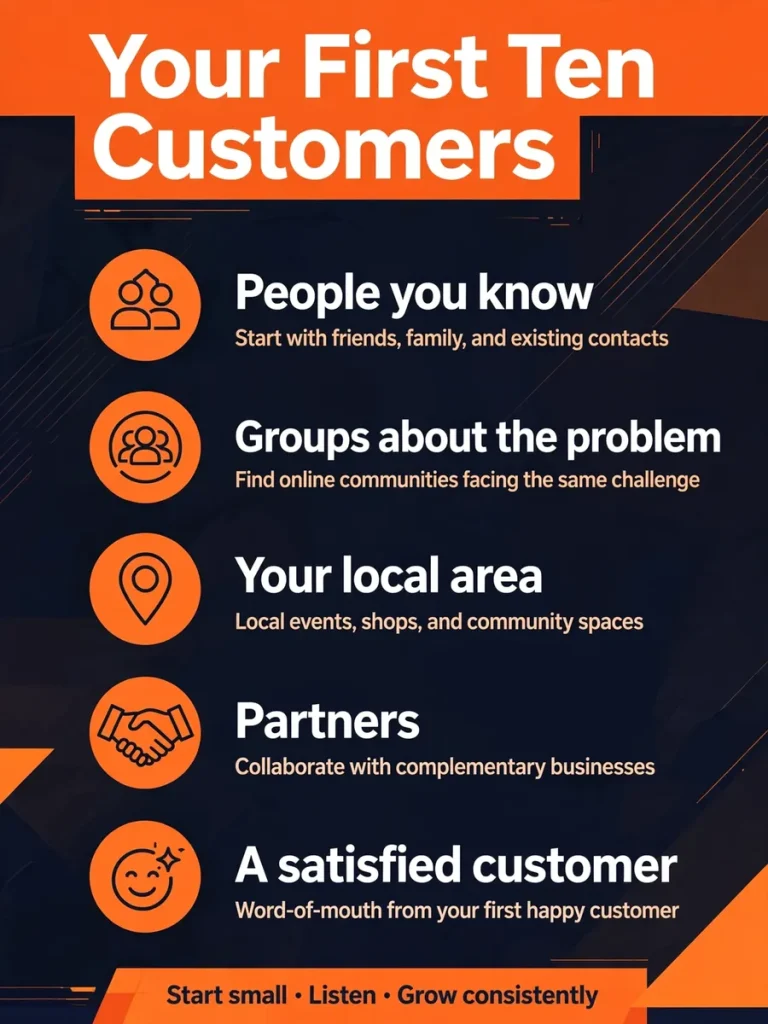
| Where to find them | What to do | What to say |
|---|---|---|
| People you know | List people with the problem | Ask for a short conversation |
| Groups about the problem | Listen, then answer questions | Invite a message if it sounds familiar |
| Your local area | Be where local people look | State the service, area, and contact |
| Partners | Match their customers to yours | Give a short description to share |
| A satisfied customer | Ask what changed | Ask for one introduction |
How the Five Places Compare
Each place gives a different kind of proof, costs a different amount of time, and can mislead in its own way.
Someone you know saying yes proves the problem is real to them, but it can also reflect goodwill toward you. Time cost stays low, because the conversation starts with trust already in place.
Replies in a group prove a stranger found the answer useful enough to respond. Listening and answering well take steady time, and a promotional tone can mislead you into counting views as interest.
Nearby yeses prove the offer works where people can see the result in person. Travel and presence cost time, and a friendly neighbourhood can mislead you into thinking demand travels further than it does.
Yeses through a partner prove the partner’s trust transferred to you. Building the relationship takes time first, and a warm introduction can mislead you into skipping the question of whether the offer fits.
Recommendations from past buyers prove the work itself earned them. Nothing beyond good work is needed, yet one happy buyer can mislead you when their problem was unusual.
Methodology
This method was put together in November 2026 from the steps in this guide. Start with people you know, listen where the problem is discussed, and turn one customer into the next.
Each step was checked against the others, so the order follows the way a first sale usually happens. No outside study or dataset was used, and no numbers here come from external research.
Its limits are plain: it does not cover paid advertising, and it has not been tested across different industries.
Draf awal dibantu AI pada November 2026; seluruh isi diperiksa manual.
Frequently Asked Questions
Where should I look for my first ten customers?
Begin with people you already know, groups where the problem is discussed, and your local area. Those three places give you real conversations quickly, and each conversation teaches you something about the offer.
Do I need ads to find my first ten customers?
No, you do not need ads to find your first ten customers. Direct conversations, useful answers, local visibility, and introductions from partners can bring your first ten buyers without paid promotion.
What should I offer to a first customer?
Small, clearly defined first steps with a clear result and a fair price work well. Such a step lowers the risk for the buyer, and it gives you a result you can deliver well.
How do I ask someone to buy without feeling pushy?
Describe the problem, name the offer in one sentence, and ask one simple question about whether a short conversation would help. Keeping the message clear respects the reader, and a polite no is a useful answer.
How long should finding the first ten customers take?
There is no fixed time, because the answer depends on the offer, the price, and how often you start real conversations. Focus on steady conversations and completed first steps, rather than on a deadline you cannot control.
Your Next Step Is a Conversation
Ten customers will not appear just because the website is ready. Conversations with the right people about a problem they already have are what bring them.
Pick one place from this guide, write a short list of people with that problem, and start one honest conversation today.
Every conversation will sharpen the offer, and each completed first step will make the next one easier to explain. Steady work like this finds a new business its first ten customers without ads, and earns the trust to find the next ten.