

Gambar utama: Ilustrasi AI.
You have the idea at 7 p.m., a notebook full of names, and a quiet fear that you will spend weeks building something nobody wants. Tonight is the test, not the launch.
This article is general information, not financial advice. For decisions about your money, consult a qualified financial adviser.
Summary
- Five real buyers, five questions, and one clear offer fill a single evening.
- Small payments prove demand more strongly than praise, sign-ups, or waiting-list joins.
- Before bed, one sentence decides the outcome: keep going, change one thing, or let the idea go.
- No website, logo, or finished product is needed for the test.
To validate business idea fast, you need real reactions from real buyers, not more praise from friends. Five conversations and one clear offer give you that evidence in a single evening, and a one-sentence decision closes it.
Across the evening, five conversations, one simple offer, and a close watch on what happens next shape the test. By bedtime, the choice should be clear: keep going, change the idea, or let it go.
Starting Your Own Business Overnight uses one rule here: test first, then spend. Neither a logo, a website, nor a perfect plan is needed to begin.
What Does It Mean to Validate Your Business Idea Fast?
To validate your business idea fast means to check, in hours rather than weeks, whether enough people want your offer enough to act on it. Applause is not the point.
One clear sign matters: someone willing to pay, sign up, or book.
Even a fast test needs a real offer, because people can only react to something concrete. People cannot react to a feeling, so a vague idea cannot be tested.
Naming the buyer, the problem, and the result makes the test possible. Validation is not a survey that asks, ‘Would you buy this?’
Think of it as a small, honest experiment with a real choice at the end. When people choose it, you have something.
A refusal still leaves a useful lesson about the buyer, the price, or the promise.
Start With One Buyer, One Problem, One Promise
One buyer, one problem, and one promise keep the test honest, because three audiences tell you nothing. Speak only to the person who feels the problem most often tonight.
Choose one buyer
Choose the buyer who already spends time or money on this problem. Busy parents who pay for after-school help test better than strangers who only like the idea in theory.
Put the buyer down in one line. Descriptions that will not fit in one line show the idea is still too broad for tonight.
Name one problem
Use the buyer’s own words to name the problem. For example, a buyer might say, ‘Two hours disappear into meal planning every Sunday.’
Vague wishes such as ‘People want to eat better’ cannot be tested.
Consider what happens when the problem stays unsolved. An answer of ‘not much’ means the problem may not be strong enough to support a business yet.
Make one promise
Make one promise that a buyer can understand in five seconds. Results belong in the promise, not the method.
Take this as an example of a promise: “Your family’s dinners for the week, planned in 15 minutes.” Labels such as ‘smart meal-planning platform’ say nothing about the result.
Deliver the promise by hand, so keep it small. Proof matters tonight, not scale, because one honest answer beats a polished plan.
The One-Evening Plan, Hour by Hour
About three hours cover the whole evening, with one job for each hour. Following the order leaves you with notes, names, and a decision.
- First 30 minutes: Sharpen the offer. Put one buyer, one problem, and one promise on a single page.
- Following 60 minutes: Talk to three buyers. Ask about their last experience, listen, and note their exact words.
- Then 30 minutes: Write the simple offer. Include who it is for, what they get, the price, and the start date.
- Next 45 minutes: Two more buyers see the offer, and each is asked for a real next step.
- Last 15 minutes: Count the actions. Decide whether to keep going, change one thing, or let the idea go.
| Step | What it proves |
|---|---|
| Sharpening the offer (first 30 minutes) | Whether one buyer, one problem, and one promise fit on a single page. |
| Three buyer talks (following 60 minutes) | Stories about their last experience show whether the problem is real. |
| Drafting the simple offer (then 30 minutes) | Whether buyers face a real choice with a real price, not just curiosity. |
| Sharing the offer (next 45 minutes) | Two more buyers meet the offer and show, through a real next step, whether they will book, sign up, or pay. |
| Counting the actions (last 15 minutes) | Which of three paths fits the evidence: keep going, change one thing, or let the idea go. |
Set a timer for each step, and stop when it rings. Longer evenings do not make the evidence stronger.
Extra hours mostly bring tiredness, and tired founders read polite answers as yeses. Keep the five talks’ exact words on one page.
Names, exact words, and actions on one simple page are enough. Tomorrow, when the excitement fades, those exact words will still matter.
Talking to Real Buyers Tonight
Begin with real buyers’ last experience with the problem, not with your idea. Truth shows in stories about the past.
Guessing what five buyers might do proves nothing without their past stories.
Find five people who match your buyer. Message people you already know, join a group where they gather, or ask one person to introduce you to another.
Warm introductions beat cold posts. Short talks stay focused on their life, not your plan.
Ask these five questions
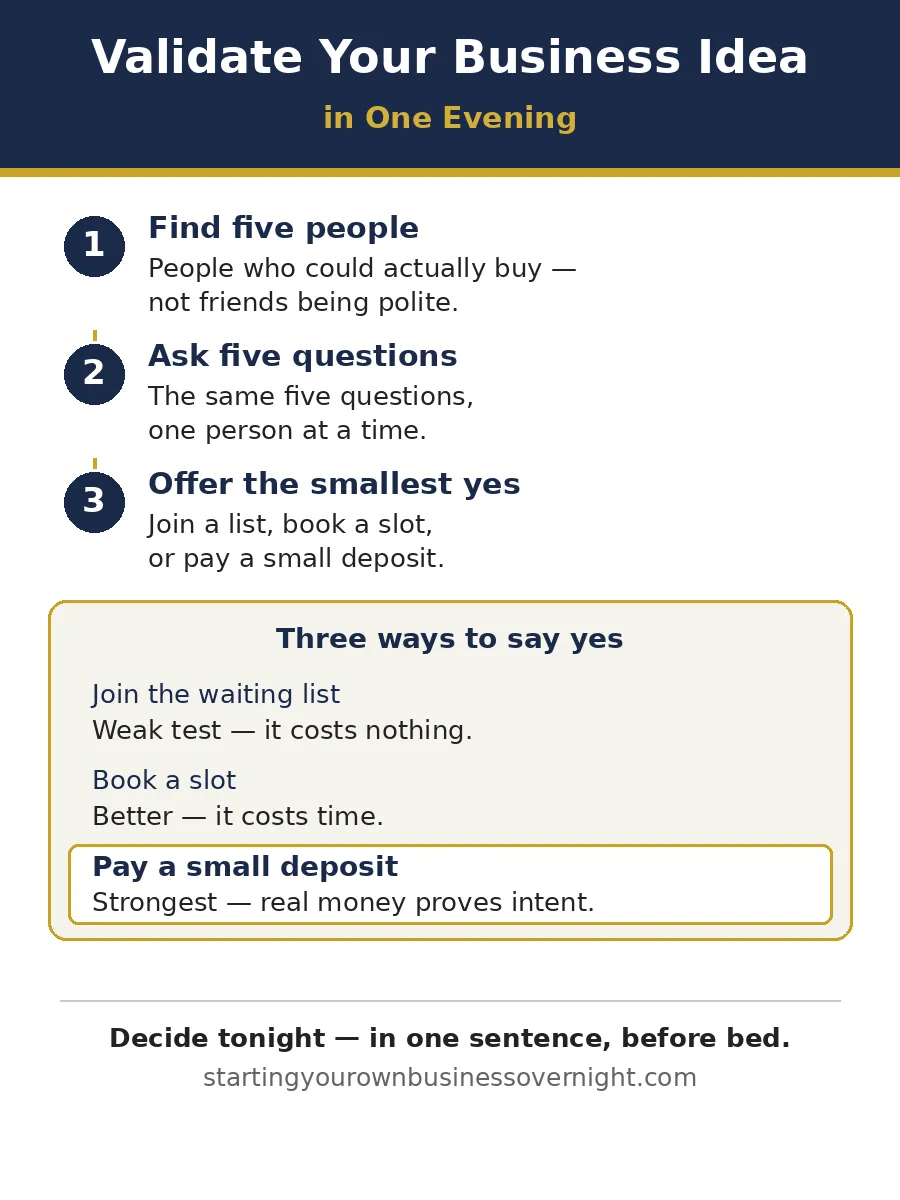
- When did you last face this problem, and what happened?
- What did you try next, and how did that go?
- What did that cost you in time, money, or stress?
- Describe what a good solution would look like for you.
- If I offered this promise for this price, what would you do next?
Listen for stories, not compliments. Stories with a date, a cost, and a workaround carry real weight.
Kind words such as ‘Sounds nice’ prove nothing.
Note their exact words after each talk. Tidying them into your own language loses the detail that matters.
Their words will later become your offer, your headline, and your sales page.
Close each talk with a real next step. Agreement to receive details and try the offer this week shows more than praise for the idea.
How to Test Demand Without a Website or a Product
Demand can be tested without a website or a product by offering the result in the simplest possible way.
Real choices with real prices turn a chat into a test, and polite conversation alone proves nothing.
Make a simple offer page
Draft a short offer in a document or a form. Include who it is for, what they get, what it costs, and when it starts — and nothing else.
Plain language and a clear price make the offer easy to judge. Hiding the price tests curiosity, not demand.
Costs need to stay visible before anyone can say yes.
Three ways buyers can say yes
- Joining a short waiting list with a start date shows who wants in.
- Booking a paid trial or a first session shows who will pay for the result.
- Paying a small deposit to reserve a place shows who is ready now.
Between the three, a small payment carries the most weight, because it costs the buyer something real. The amount varies by product, and the principle stays simple: small enough to feel low-risk, real enough to prove intent.
Waiting lists alone give a weak test, because joining costs nothing. Beside it, a paid step, even a small one, makes the result honest.
Share the offer only with the people you spoke to, plus a small group that matches your buyer. Wide posts to everyone bring likes from people who will never buy.
Watch actions, not reactions. Clicks, sign-ups, bookings, and payments count as evidence.
Comments saying ‘Great idea!’ are encouragement, and encouragement does not pay for a business.
Reading the Answers Honestly
Count actions before opinions when you read the answers. Three people who pay beat thirty people who only say they like it.
Green signs: keep going
- The problem comes up without prompting, with a recent example attached.
- Questions about the price, the date, or how it works keep coming.
- An introduction to a friend with the same problem is offered.
- Bookings, sign-ups, or payments happen without any pushing.
Yellow signs: change one thing
- Interest is there, but more thinking time is needed.
- A free version is requested before any trial.
- Buyers like the idea, but not right now.
Yellow signs call for changing one thing, not everything. Change the buyer, the price, or the promise, and test again.
Changing all three at once hides what worked. Small tests and clear notes keep the lesson visible.
Red signs: let it go for now
- Almost no one replies, or no one will talk about the problem.
- No one will pay, book, or join, even after a clear offer.
- Real problems can still lack the urgency that makes people pay to solve them.
Useful red signs are not failures. They save weeks of building and free you to test a stronger idea.
Dropping a red-sign idea tonight saves weeks of building the wrong offer.
Before bed, write your decision in one sentence. Working decisions read like this: ‘Keep testing this offer with busy parents, at this price, for one more week.’
Vague plans such as ‘I will think about it’ are not decisions.
How the Demand Tests Compare
Three demand tests follow a different kind of proof. Ranking them side by side shows why a small payment carries the most weight.
| Demand test | What it proves | What it fails to prove |
|---|---|---|
| Waiting list | That people will leave a name for a future version. | That anyone will pay, book, or commit time. |
| Poll or signup | Clicks, answers, or joins that cost the person nothing. | Any sign of willingness to pay or commit time. |
| Small payment or deposit | Willingness to pay now, shown by money changing hands. | Long-term demand, repeat buying, or a workable full price. |
What to Do Tomorrow Morning
Follow up with everyone who said yes, and thank everyone who said no. Momentum matters more than perfection at this stage.
Send the details you promised and confirm the first date. First payments mark the point where a buyer commits, before any website goes live.
Weak tests call for changing one part and running a second evening. Keep the same buyer and change the promise, or keep the promise and change the buyer.
Test again before spending on tools, ads, or a brand. Strong tests still call for a small offer.
Serve the first few buyers by hand, learn what they actually need, and improve the offer from their feedback. Growth can wait until the offer works.
Your First Ten Customers continues this series with the next step after a yes. Meanwhile, your job stays simple: serve the people who said yes.
Mistakes That Make Validation Useless
Wrong people, leading questions, or praise taken as proof make validation useless. Avoiding these mistakes keeps tonight’s answers honest.
- Asking friends and family only: They want to encourage you, so they will say yes even when they would never buy.
- Asking, ‘Would you buy this?’: Guesses about the future are often kind rather than true.
- Explaining the idea before listening: Once you pitch, people react to your pitch, not to their own problem.
- Offering it for free: Free offers test interest, not demand, because they cost nothing to accept.
- Counting likes and comments: Likes take one second and tell you nothing about who will pay.
Every mistake has the same effect: it makes a weak idea look strong. Strong ideas win real yeses in the five talks, without praise or leading questions.
A fair test still leaves a strong idea with bookings, sign-ups, or payments.
Spotting one of these in yourself calls for a pause and a fix. Ask a stranger, ask about the past, or add a price.
Honest answers beat kind ones, one to ten.
Who This Method Does Not Suit
Ideas that need a license, a built product, or a long sales cycle do not fit one evening. Regulated work and heavy upfront builds need checks this quick test cannot give.
Buyers who need months to decide also fall outside this method. Long decisions need longer tests, with more buyers and more time.
Methodology
This method comes from the practice of Starting Your Own Business Overnight: five conversations, one offer, and a decision in one sentence. Outside studies and expert reviews did not shape these steps.
November 2026 is when these steps were put together for a single evening of testing. Each step was checked against the five-step plan and the five questions in this article.
Single evenings cannot prove everything, and five conversations are a small sample. Results also depend on finding the right buyers, not just any five people.
AI assisted the first draft of this article, and every step was checked against the method described in the article.
Your Evening Starts Now
Your evening starts now, with one buyer, one problem, and one honest test. Five talks, one clear offer, and one honest test are all the evening needs to begin.
Talk to five people, make one clear offer, and note what they do. Then decide, and take the next small step.
Businesses begin this way, one evening at a time.
Short steps come next. Open your notebook, write down one buyer, and send the first message.
Frequently Asked Questions
How long does it take to validate a business idea fast?
Talking to five buyers and offering a real choice in one evening shows whether the idea deserves more time.
Single evenings cannot prove everything, but they can show a clear signal.
How many people should I talk to?
Conversations with five people who match your buyer should reveal a pattern in what they do.
Honest talks in that number are enough to spot a strong signal or a clear warning.
With nobody willing to pay yet, what should change?
Change one part of the offer and test again before giving up.
Wrong buyers, high prices, or unclear promises can each explain the silence.
Can I validate a business idea fast without spending money?
Yes, messages, calls, and a simple form can test demand without spending money.
Ads, websites, and finished products are not needed to learn whether people will act.
After a failed test, what comes next?
Notes from the test stay useful for a new version or a new idea.
Failed tests teach cheap lessons, and they do not mean a failed business.